
Choosing scrubs for a healthcare team is different from buying one uniform for one person. A clinic, dental office, home care group, veterinary team, or medical department needs uniforms that look consistent, fit different body types, support daily movement, and remain easy to reorder when new staff members join.
A strong group scrub order should balance appearance, comfort, budget, sizing, fabric performance, laundering needs, and workplace requirements. The goal is not only to make the team look coordinated. The uniforms also need to work through real clinical routines, repeated washing, and long workdays.
Key Takeaways
- Group scrub uniforms should be selected for fit, function, and consistency, not color alone.
- Teams should choose styles with a broad size range, including men’s, women’s, petite, regular, tall, and jogger options where needed.
- Fabric matters for team satisfaction because comfort, breathability, stretch, and laundering affect everyday wear.
- Embroidery and logo placement should be planned early so the final uniform looks professional and remains practical.
- A clear reorder process helps teams avoid mismatched colors and discontinued styles when new employees need uniforms later.
Healthcare offices comparing group scrub uniforms should start with role needs, staff sizing, brand availability, and long-term reorder planning before finalizing a team uniform program.
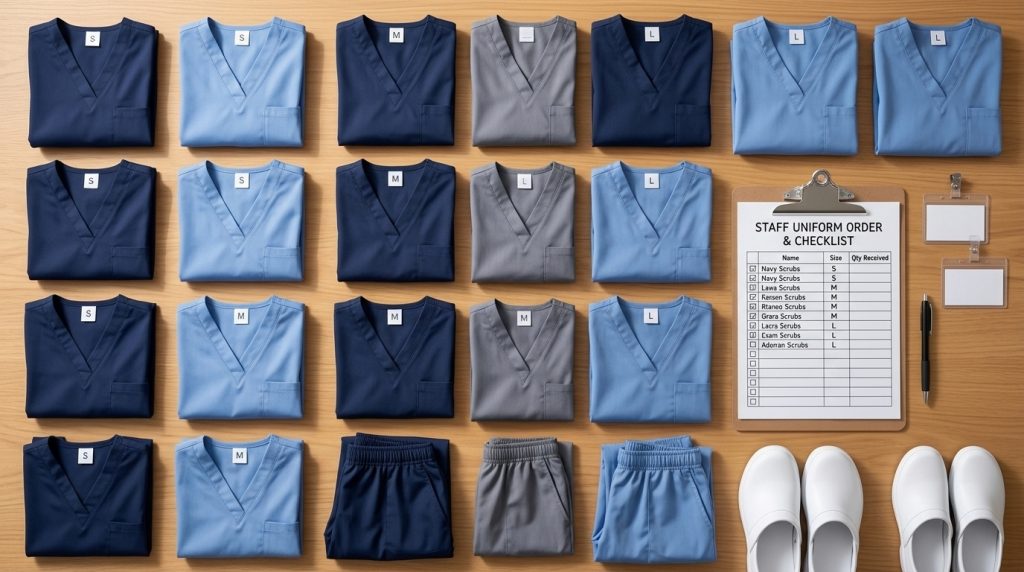
Why Group Scrub Orders Need a Different Process
Individual scrub shopping is personal. Group scrub buying is operational. One worker may care most about jogger pants, while another needs tall inseams, a relaxed fit, or extra pocket space. A clinic manager or office administrator has to choose a uniform program that works for the whole team.
Group uniforms also affect first impressions. In patient-facing settings, coordinated scrubs can make a team look organized and easier to identify. For multi-role practices, color-coded uniforms may help distinguish clinical staff, front-office staff, assistants, technicians, and providers.
The U.S. Bureau of Labor Statistics notes that healthcare workers are employed across hospitals, clinics, physicians’ offices, nursing facilities, outpatient centers, home healthcare, and other settings. This range of environments shows why uniform needs can vary by role and workplace. The BLS overview of healthcare occupations is useful for understanding how broad the healthcare workforce is.
For group orders, the best scrub choice should answer three questions:
- Will the uniforms fit the whole team comfortably?
- Will the uniforms support the work being performed?
- Will the same or similar pieces be available for reorders later?
If any of these answers are weak, the group order may create problems after the first purchase.
Start With the Healthcare Setting
Different healthcare settings place different demands on uniforms. A pediatric dental office may want bright colors and comfortable movement. A surgical support team may need stricter color consistency. A veterinary clinic may prioritize durable fabric and easy laundering. A home care team may need a polished but practical uniform that works outside a traditional clinic.
Clinics and Physician Offices
Clinics and physician offices often need uniforms that look polished and approachable. Staff may move between front-desk tasks, patient intake, exam rooms, and administrative work. Scrubs should be comfortable but neat enough for patient-facing service.
Useful features may include:
- Modern but not overly tight fits
- Easy-care fabric
- Professional color options
- Jackets or layering pieces
- Embroidery-ready tops
- Matching pants across size ranges
Dental Offices
Dental teams may need coordinated uniforms that support movement, chairside work, and frequent cleaning. Since dental offices often emphasize a unified brand appearance, color consistency and embroidery placement can be important.
Veterinary Teams
Veterinary teams may need scrubs that support bending, lifting, cleaning, and frequent movement. Durable fabric, secure pockets, stretch, and darker colors may be practical depending on the environment.
Home Care and Hospice Teams
Home care and hospice teams may travel between locations, so uniforms should be comfortable, professional, and easy to maintain. A polished scrub set can help staff look identifiable and prepared while working in different environments.
Build the Order Around Real Staff Sizing
Sizing is one of the biggest challenges in group scrub orders. A uniform program that only looks good on a sample rack may not work for the full team. The order should reflect real staff sizing needs before final styles are selected.
Include Men’s and Women’s Fits
Some teams make the mistake of choosing only one style for everyone. Men’s and women’s scrub fits can differ in shoulder width, torso shape, rise, hip room, and leg cut. Offering appropriate fit options helps improve comfort and appearance.
Consider Petite, Regular, and Tall Lengths
Pant length matters. If pants are too long, they can drag or bunch at the ankle. If they are too short, they can look awkward and feel uncomfortable while sitting or walking. For larger teams, petite, regular, and tall options may be necessary.
Account for Different Fit Preferences
Some staff members may prefer relaxed fits. Others may prefer joggers, tapered pants, or modern-fit tops. A good group program can often stay coordinated while allowing reasonable fit variation within the same color family.
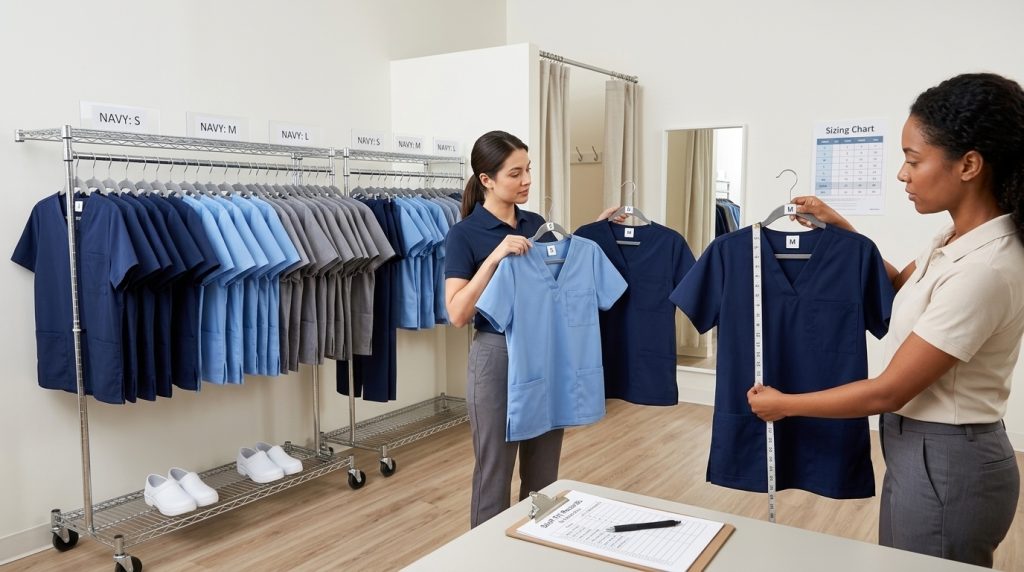
Before placing a full order, teams should gather:
- Staff names
- Top sizes
- Pant sizes
- Preferred inseam lengths
- Men’s or women’s fit preferences
- Jacket or lab coat needs
- Role-specific requirements
- Embroidery name or credential details if needed
This reduces exchanges and helps the final order arrive closer to correct.
Choose Fabric Based on Workday Demands
Fabric affects how employees feel about the uniform. A color may be approved by management, but the team will judge the scrubs by how they feel during a shift.
Stretch and Recovery
Stretch helps staff move comfortably. Recovery helps fabric return to shape after movement. For clinical roles that involve bending, reaching, walking, or sitting, stretch fabric can make the uniform more comfortable.
Breathability
Breathable fabric can help staff stay more comfortable in active settings. Breathability depends on fabric weight, weave, fiber blend, and fit. A fabric that feels too heavy or stiff may become uncomfortable during long workdays.
Durability
Group uniforms are often worn frequently and washed repeatedly. Durable fabric can help reduce replacement costs over time. Teams should consider how often employees will wear the scrubs and how frequently they will be laundered.
Easy Care
Easy-care fabrics help reduce friction for busy workers. Garments that wrinkle badly, shrink easily, or require special handling may not be practical for full-team use.
The CDC provides guidance on healthcare laundry and bedding, including cleaning considerations for textiles used in healthcare settings. Teams should always follow employer policies, garment care labels, and any applicable infection-control requirements.
Plan Color Strategy Carefully
Color is often the first thing teams discuss, but it should not be the only deciding factor. A color strategy should support the workplace’s professional image and make reordering easier.
Single-Color Uniforms
A single-color uniform program creates a clean, consistent appearance. It is often easiest to manage because all staff wear the same color. This can work well for small clinics, dental offices, and private practices.
Role-Based Color Coding
Some healthcare teams use different colors by role or department. For example, clinical assistants, front-office staff, providers, and technicians may wear different colors. This can help patients and staff identify roles quickly.
Accent Colors
Some teams keep the main scrub color consistent but add variation through jackets, underscrubs, or embroidered details. This can create a unified appearance without making every piece identical.
Reorder-Friendly Colors
Not every color is equally easy to maintain across time. Teams should consider whether the chosen color is likely to remain available. Standard medical colors are often easier to reorder than seasonal colors.
Think About Branding and Embroidery Early
Embroidery can make team uniforms look more professional, but it should be planned before the order is finalized. Logo size, thread color, name placement, credentials, and garment fabric can all affect the final result.
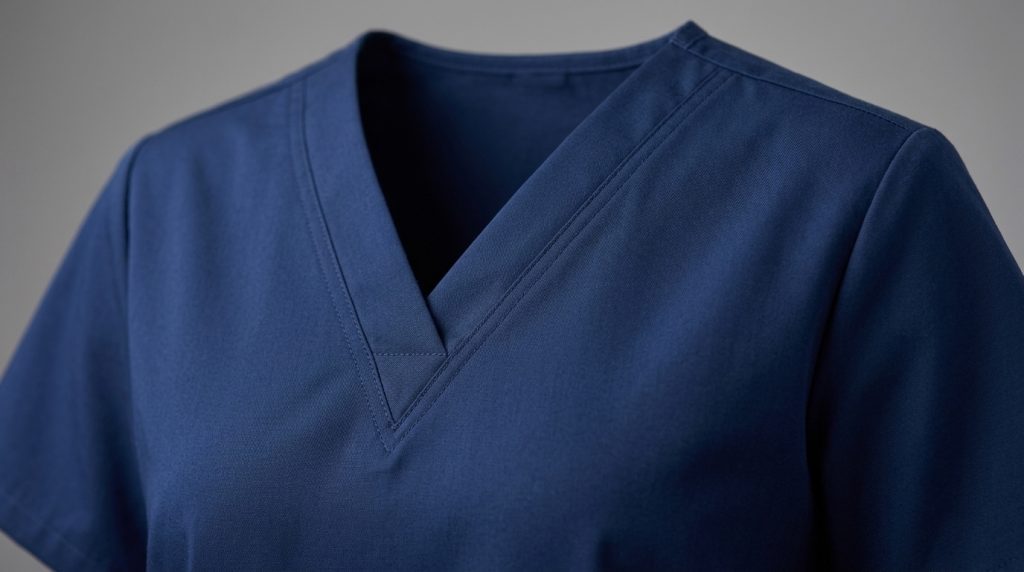
Logo Placement
Common embroidery locations include the left chest area, sleeve, or jacket front. The placement should be visible but not distracting. It should also work across different top sizes and body shapes.
Name and Credential Formatting
Healthcare teams may include names, credentials, departments, or job titles. Formatting should stay consistent across the team. For example, decide whether credentials appear after names, under names, or not at all.
Fabric Compatibility
Some fabrics, pockets, seams, or top styles may not be ideal for embroidery placement. Teams should confirm embroidery compatibility before choosing the final scrub style.
Proofing Process
Before approving embroidery, review:
- Logo size
- Thread colors
- Name spelling
- Credential spelling
- Placement
- Font style
- Visibility on the scrub color
A careful proofing process helps prevent costly errors.
Balance Budget With Long-Term Value
Group buyers often need to manage cost carefully. However, the cheapest option is not always the best value. If scrubs shrink, fade, lose shape, or feel uncomfortable, staff may need replacements sooner.
A better approach is to compare cost against expected use.
Affordable Uniform Programs
Affordable scrubs can work well for larger teams, backup uniforms, students, short-term staff, or roles with lower wear intensity. They can help keep the initial investment manageable.
Premium Uniform Programs
Premium scrubs may offer better fabric feel, stronger stretch, shape retention, and a more polished appearance. They may be worth considering for full-time staff, patient-facing teams, and workplaces that want a more refined look.
Mixed Uniform Programs
Some teams use a mixed approach. For example, daily clinical staff may receive higher-performance scrubs, while backup or seasonal staff may use more basic options. The key is keeping colors and branding consistent.
Group Uniforms and Workplace Safety
Scrubs support professional appearance and daily comfort, but they are not a substitute for required safety equipment. OSHA explains that personal protective equipment is used to reduce exposure to workplace hazards that may cause injuries or illnesses.
Depending on the setting, healthcare workers may still need gloves, gowns, masks, eye protection, respirators, or other protective items. Group scrub policies should align with workplace safety rules, infection-control procedures, and employer requirements.
Create a Clear Ordering and Reordering Process
A group uniform order should not end after the first purchase. Healthcare teams change over time. New employees join, staff members change sizes, garments wear out, and departments may expand.
A strong reorder process helps prevent mismatched uniforms later.
Keep a Uniform Record
The office manager or team lead should keep a simple record of:
- Approved scrub brand or collection
- Approved colors
- Approved top style
- Approved pant style
- Approved jacket or lab coat style
- Embroidery details
- Size list
- Reorder contact or process
- Backup options if a style is discontinued
Plan for New Employees
New employees should be able to order uniforms quickly without restarting the entire selection process. A saved style and embroidery standard makes onboarding easier.
Avoid Discontinued Style Problems
Scrub styles can change over time. Teams should ask whether the selected styles are core items or seasonal pieces. Core items are usually safer for long-term group programs.
When Onsite Fittings Can Help
Onsite fittings can be useful for larger teams. Instead of asking each employee to guess sizes, staff can compare garments in person and choose more accurately. This can reduce returns and improve team satisfaction.
Onsite fitting support may be especially helpful when:
- The team has many employees
- Staff have different body types
- Men’s and women’s options are both needed
- Petite and tall lengths are required
- A new brand is being introduced
- Embroidery makes exchanges more difficult
- The order includes several departments
A team researching medical uniforms for teams should consider whether fitting support, embroidery planning, and reorder help are available before choosing a final vendor.
For local planning, a verified West Chester medical uniform store listing can help office managers confirm store details, location access, and visit planning.
What to Include in a Team Scrub Policy
A clear uniform policy prevents confusion. The policy does not need to be complicated, but it should answer common questions before staff place orders.
A practical scrub policy may include:
- Required scrub color
- Approved brands or collections
- Approved top styles
- Approved pant styles
- Jacket or underscrub rules
- Lab coat requirements
- Embroidery rules
- Footwear guidelines
- Replacement schedule
- Laundering expectations
- New-hire ordering process
This policy helps staff understand what is required and reduces inconsistent purchases.
Common Mistakes in Group Scrub Orders
Group orders can become difficult when details are skipped. Most problems come from unclear sizing, weak communication, or choosing a style too quickly.
Avoid these common mistakes:
- Ordering before collecting accurate staff sizes
- Choosing color before confirming size availability
- Ignoring men’s and women’s fit differences
- Forgetting petite and tall lengths
- Selecting seasonal colors that are hard to reorder
- Approving embroidery without proofing names and credentials
- Buying the lowest-cost option without checking durability
- Choosing a style with limited reorder availability
- Not creating a uniform record for future hires
- Ignoring workplace safety and laundering policies
A careful planning process can prevent most of these issues.
Final Thoughts
Healthcare team scrub orders should be built around consistency, comfort, sizing, fabric, branding, and long-term reorder needs. A well-planned uniform program can help a clinic or healthcare group look organized while supporting staff through real workday demands.
The best group scrub program is practical from the start. It should offer fit options for different body types, fabrics that match the work environment, embroidery that looks professional, and a reorder process that keeps the team consistent over time. For office managers and healthcare leaders, the right planning process can make uniform buying simpler for everyone involved.

FAQs
How should a clinic choose scrubs for a group order?
A clinic should start by confirming workplace colors, staff sizes, role requirements, fabric preferences, embroidery needs, and budget. The best group scrub order should fit different body types, support daily movement, look consistent, and remain easy to reorder as new employees join.
What information is needed before placing a group scrub order?
A group order should include staff names, top sizes, pant sizes, inseam needs, men’s or women’s fit preferences, approved colors, embroidery details, and any role-specific uniform requirements. Collecting this information early helps reduce sizing errors and delays.
Should healthcare teams choose one scrub style for everyone?
One style can work for small teams, but larger teams often need fit flexibility. Men’s and women’s cuts, petite lengths, tall lengths, joggers, jackets, or different top shapes may be necessary. The team can still look coordinated if the color and branding stay consistent.
Are embroidered scrubs good for clinics?
Embroidered scrubs can help clinics look more professional and organized. They may include a logo, staff name, role, or credentials. Before ordering, teams should confirm placement, spelling, thread color, garment compatibility, and proof approval to avoid costly mistakes.
How many scrub sets should each employee receive?
The number depends on schedule, laundry routine, and workplace policy. Full-time clinical staff may need several sets, while part-time staff may need fewer. Teams should also consider backup uniforms, jackets, lab coats, and replacement needs over time.