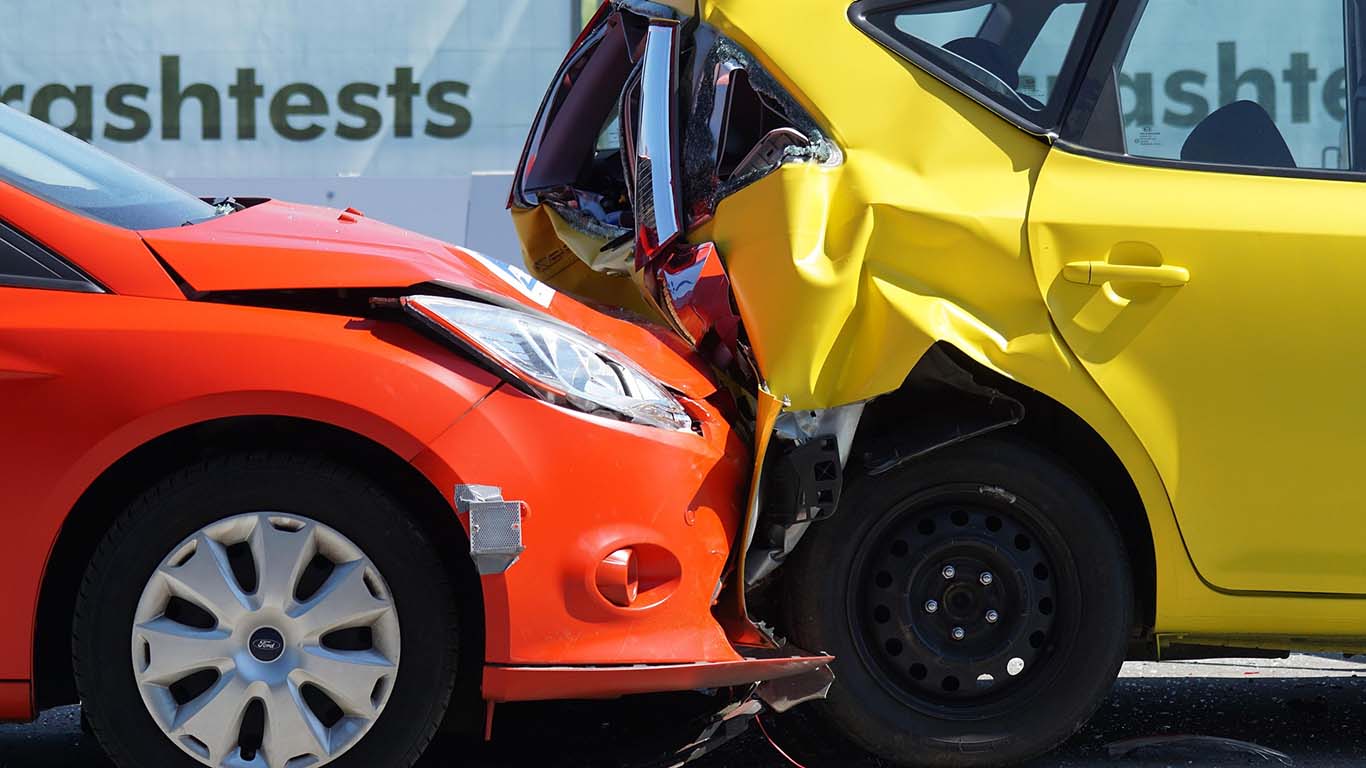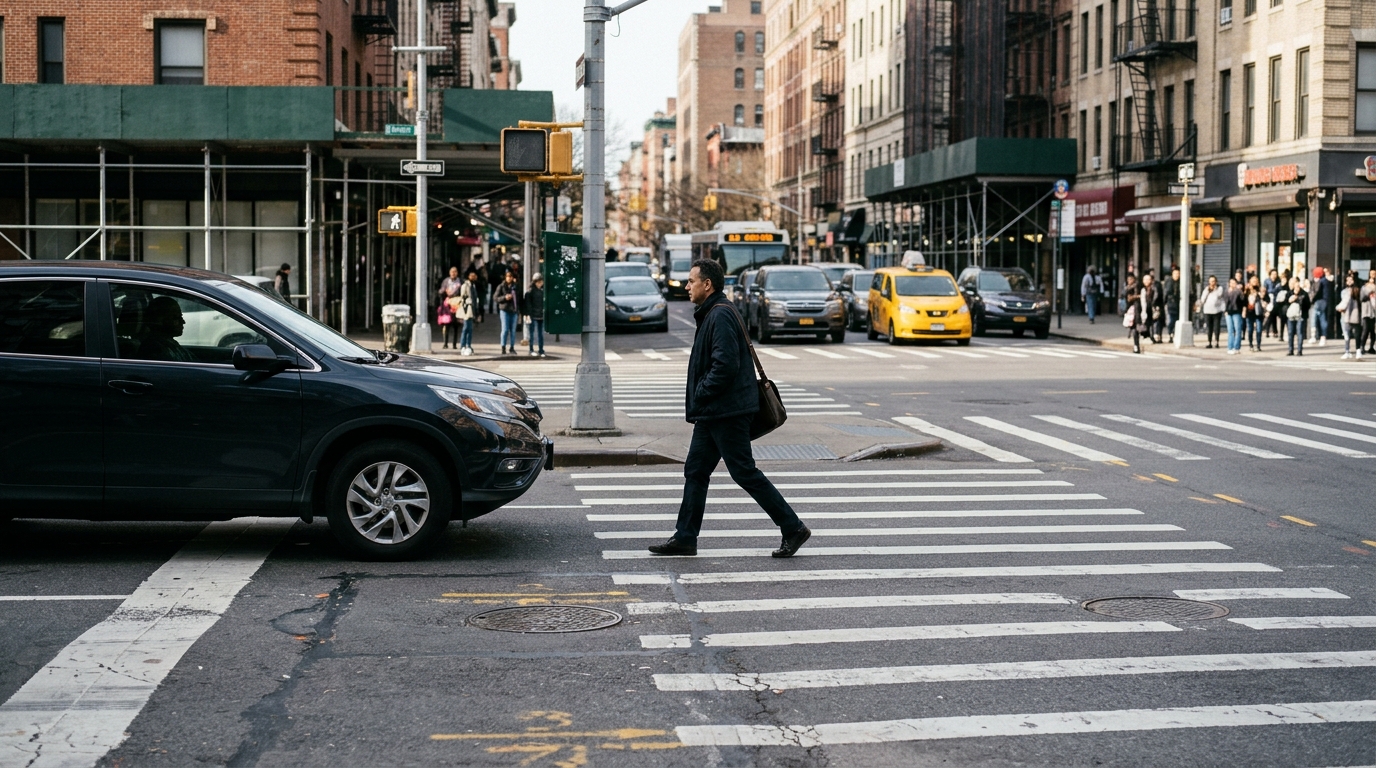
Pedestrians injured at crosswalks or intersections in New York may pursue compensation when a driver’s negligence causes a collision. The outcome depends on right-of-way rules, traffic signals, evidence of fault, medical documentation, and applicable insurance coverage. Even when a pedestrian shares some responsibility, New York’s comparative negligence law may allow partial recovery.
Understanding these rules can help injured pedestrians preserve important evidence, identify potentially responsible parties, and make informed decisions about insurance claims and legal action.
Quick Answer: Who Is Responsible for a Pedestrian Accident at a Crosswalk?
A driver may be legally responsible for a pedestrian accident when they fail to yield, disregard a traffic signal, drive distracted, or otherwise fail to exercise reasonable care.
Important factors include:
- Right-of-Way Rules: Whether the pedestrian was crossing legally and whether the driver was required to yield.
- Traffic Signals: Whether the pedestrian and driver followed applicable traffic-control devices.
- Driver Conduct: Speeding, distraction, failure to maintain a lookout, or unsafe turning.
- Pedestrian Conduct: Whether the pedestrian entered traffic unexpectedly or violated a crossing rule.
- Accident Evidence: Camera footage, witness testimony, physical evidence, and police records.
- Medical Documentation: Evidence establishing the nature, severity, and consequences of injuries.
New York law requires drivers to exercise due care to avoid colliding with pedestrians. However, determining civil liability requires evaluating the particular circumstances of the accident.
What Are New York’s Pedestrian Right-of-Way Laws?
New York establishes specific rules governing interactions between vehicles and pedestrians.
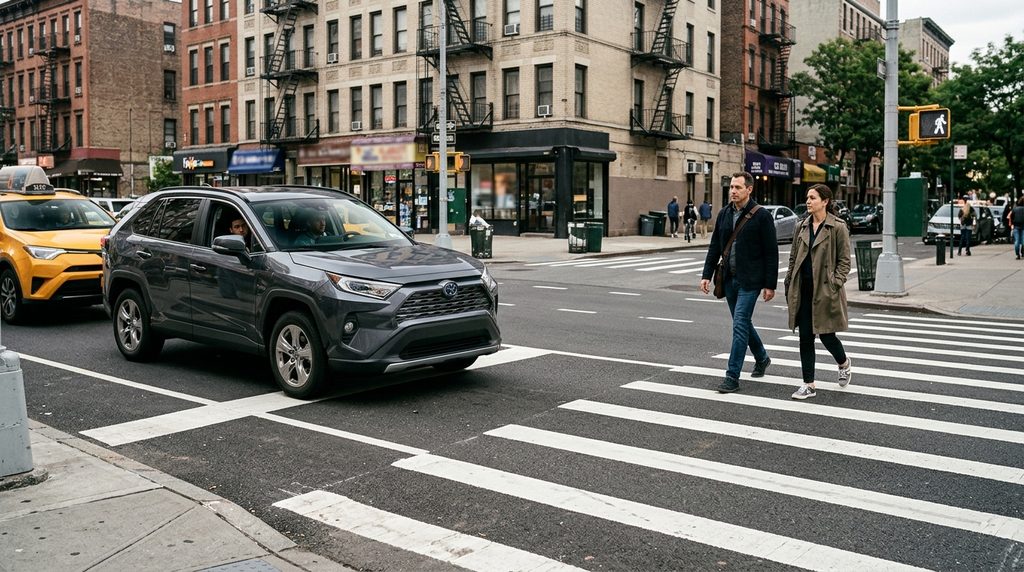
These rules address marked crosswalks, intersections without traffic signals, pedestrian signals, and crossings outside designated crosswalk areas.
Understanding the applicable law is essential because a pedestrian’s location and the condition of the traffic signals can affect the liability analysis.
When Must Drivers Yield at Crosswalks?
Under New York Vehicle and Traffic Law Section 1151, drivers generally must yield to pedestrians crossing within a crosswalk when traffic-control signals are absent or not operating, subject to statutory exceptions.
Drivers may need to slow down or stop to allow pedestrians to cross safely.
The law also prohibits drivers from overtaking a vehicle stopped at a crosswalk to permit a pedestrian to cross.
NYSenate.gov
A driver’s failure to follow these requirements may become important evidence in a personal injury claim.
What Happens at Signal-Controlled Intersections?
At intersections with operating traffic signals, the applicable traffic and pedestrian-control signals govern when people may cross.
Pedestrians generally must obey the signals directed toward them. Drivers must follow traffic lights, comply with turning rules, and remain attentive to pedestrians who may be lawfully crossing.
A green traffic signal does not give a driver unlimited permission to proceed without considering pedestrians.
The New York State Department of Transportation’s pedestrian safety guidance explains relevant rights and responsibilities under state traffic law.
dot.ny.gov
Do Unmarked Crosswalks Count?
Yes. New York law recognizes certain unmarked crosswalks at intersections.
An intersection does not necessarily need painted crosswalk stripes for pedestrian crossing rules to apply.
However, not every location near an intersection qualifies as a legal crosswalk. Roadway configuration, statutory definitions, and traffic-control conditions matter.
Identifying the exact crossing location is therefore important when evaluating responsibility.
Can a Pedestrian Be at Fault for a Crosswalk Accident?
Yes. Pedestrians are required to follow applicable traffic laws and exercise reasonable care.
For example, New York law restricts pedestrians from suddenly entering the path of a vehicle so close that the driver cannot reasonably yield.
A pedestrian’s legal right to cross does not eliminate every responsibility to consider traffic conditions.
Crossing Outside a Marked Crosswalk
Under Vehicle and Traffic Law Section 1152, a pedestrian crossing outside a marked crosswalk or an unmarked crosswalk at an intersection generally must yield the right-of-way to vehicles on the roadway.
Additional restrictions apply in certain locations, including crossings between adjacent intersections controlled by operating traffic signals.
NYSenate.gov
Crossing outside a designated crosswalk may affect a liability analysis, but it does not automatically eliminate the possibility of compensation.
How Comparative Negligence Applies
New York follows a pure comparative negligence system.
Under CPLR Section 1411, an injured person’s share of fault generally reduces their recoverable damages in proportion to their responsibility.
Consider an accident involving $150,000 in legally recoverable damages.
Illustrative comparative fault calculation
Total damages
$150,000
Pedestrian fault
20%
Adjusted damages
$120,000
Example only. Applicable insurance limits and other legal considerations may affect actual recovery.
This rule allows an injured pedestrian to pursue compensation even when their own conduct contributed to the accident.
Does Jaywalking Automatically Prevent a Claim?
No. A pedestrian crossing outside an authorized location may be found partly negligent, but the driver’s conduct must also be evaluated.
A driver who was speeding, distracted, or otherwise negligent may still bear responsibility for the collision.
Determining fault requires examining what each person did and whether that conduct contributed to the resulting injuries.
What Causes Pedestrian Accidents at Crosswalks and Intersections?
Pedestrian collisions can occur when drivers fail to notice people crossing, misjudge traffic conditions, or disregard applicable rules.
Some accidents involve multiple contributing factors.
Drivers Failing to Yield While Turning
Left-turn and right-turn collisions can occur when drivers focus on vehicle traffic without adequately checking for pedestrians.
A pedestrian may be crossing with the appropriate signal while a turning driver enters the crossing path.
Evidence concerning the traffic signals, vehicle movements, and available visibility can help establish whether the driver acted negligently.
Distracted or Inattentive Driving
Distraction may prevent a driver from recognizing a pedestrian approaching or entering a crosswalk.
Potential distractions include mobile phones, navigation systems, passengers, and activities unrelated to driving.
A driver’s failure to maintain an appropriate lookout may become relevant even when no specific distraction is conclusively established.
Speeding and Failure to Stop
Excessive speed can reduce the time available to react and increase stopping distance.
A driver may also fail to stop at a traffic signal or disregard another vehicle that has stopped for a pedestrian.
These circumstances can create particularly dangerous conditions at busy intersections.
Poor Visibility and Roadway Conditions
Lighting, parked vehicles, obstructed sightlines, weather, and roadway design may contribute to pedestrian accidents.
However, poor visibility does not automatically excuse negligent driving.
Drivers are generally expected to adjust their conduct to reasonably foreseeable roadway and traffic conditions.
What Evidence Is Important in a Pedestrian Accident Claim?
Evidence is essential when the parties disagree about who had the right-of-way or how the collision occurred.
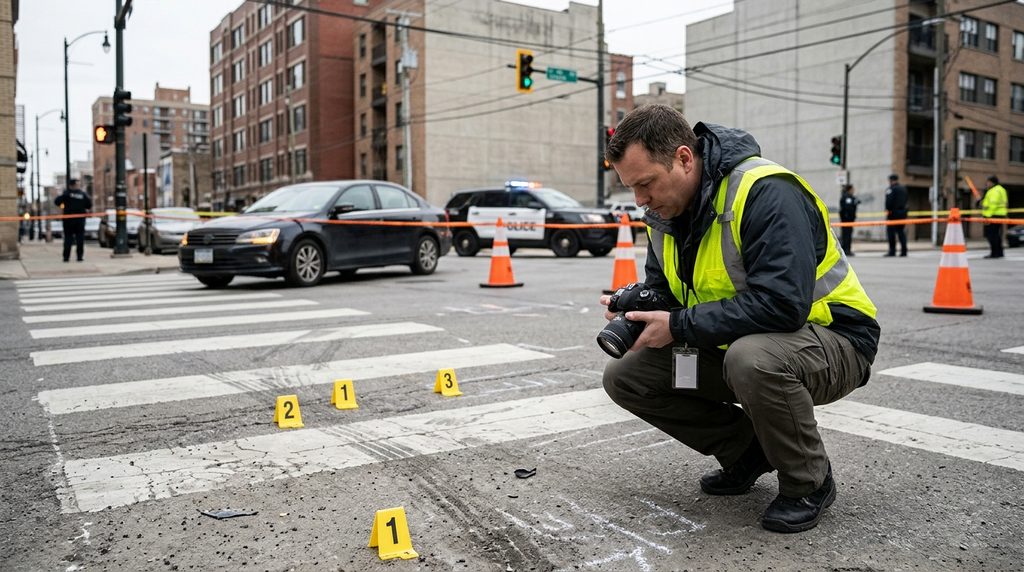
Because intersections can contain multiple traffic signals, turning movements, and potential witnesses, establishing the accident sequence may require several forms of documentation.
Traffic Cameras and Surveillance Recordings
Camera footage may show whether a pedestrian entered a crosswalk legally, whether the driver obeyed the signal, and how the collision occurred.
Relevant recordings may come from traffic cameras, commercial security systems, residential cameras, or vehicle dashcams.
Some recordings are retained for limited periods. Prompt identification and preservation may therefore be important.
Witness Statements and Police Reports
Independent witnesses may provide observations about traffic lights, turning movements, driver behavior, and pedestrian location.
Police reports can document the responding officer’s observations, involved parties, and reported circumstances.
However, a police report does not necessarily establish final legal responsibility.
Physical Evidence and Accident Reconstruction
Physical evidence may help explain collision mechanics.
| Evidence Type | Potential Importance |
| Surveillance Footage | Shows movements and traffic conditions |
| Witness Statements | Provides independent observations |
| Police Reports | Documents reported facts and initial findings |
| Vehicle Damage | May help identify collision points |
| Roadway Photographs | Shows crosswalk markings and visibility |
| Traffic Signal Records | May establish signal timing and operation |
| Accident Reconstruction | Helps evaluate technical questions about movement and impact |
Complex disputes may require qualified accident reconstruction professionals.
Not every case requires an expert, but technical evidence can be useful when liability is strongly contested.
How Do Medical Records Affect Pedestrian Accident Claims?
Medical documentation helps establish the connection between the collision and the claimed injuries.
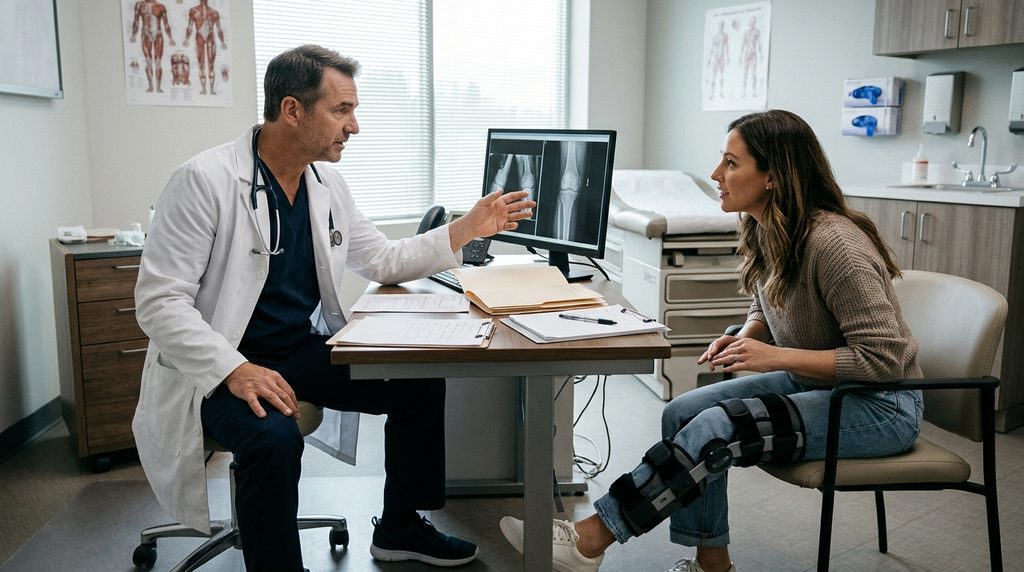
Pedestrians may experience substantial physical trauma because they lack the protective structure available to occupants of enclosed vehicles.
An accurate medical record can help demonstrate the severity of the injury, treatment requirements, and potential long-term consequences.
Common Pedestrian Accident Injuries
Pedestrian collisions may cause:
- Traumatic brain injuries and concussions.
- Spinal injuries and vertebral fractures.
- Broken legs, arms, hips, or ribs.
- Internal injuries.
- Ligament and soft-tissue damage.
- Nerve injuries.
- Long-term mobility limitations.
The seriousness of an injury cannot always be determined from visible symptoms alone.
Prompt medical evaluation is particularly important when an injured person experiences neurological changes, severe pain, or suspected internal injuries.
Establishing Medical Causation
Insurance companies may review whether the reported injuries were caused by the collision.
Relevant evidence includes initial medical evaluations, diagnostic imaging, specialist reports, and ongoing treatment documentation.
When a claimant has pre-existing medical conditions, medical professionals may need to distinguish earlier symptoms from new injuries or accident-related aggravation.
Documenting Long-Term Consequences
Some injuries affect a person’s ability to work, live independently, or participate in ordinary activities.
Medical reports may help establish future treatment needs, rehabilitation requirements, permanent impairments, and functional restrictions.
In serious cases, additional vocational or economic evidence may be necessary to evaluate future losses.
How Does New York No-Fault Insurance Apply to Injured Pedestrians?
New York’s no-fault insurance system generally provides qualifying pedestrians injured by covered motor vehicles with access to Personal Injury Protection benefits.
These benefits can help address certain economic losses without requiring an initial determination of which driver caused the accident.
What Does No-Fault Insurance Cover?
Basic no-fault coverage generally provides up to $50,000 per eligible person for qualifying economic losses, subject to statutory limitations and coverage rules.
Potential covered expenses include medical treatment, a portion of lost earnings within applicable limits, and certain necessary expenses related to the injury.
The New York Department of Financial Services explains that no-fault coverage can apply to a pedestrian injured by an insured vehicle.
Department of Financial Services+1
No-fault benefits do not automatically compensate injured pedestrians for pain and suffering.
Which Insurance Company Handles the Claim?
For a pedestrian struck by an insured vehicle, the no-fault claim generally begins with the insurer covering the vehicle that struck the pedestrian.
Different procedures may apply when the accident involves uninsured vehicles, unidentified drivers, or other unusual circumstances.
The applicable insurance policy and statutory rules determine where the claim should be submitted.
What Is the No-Fault Filing Deadline?
New York generally requires written notice of a no-fault claim within 30 calendar days after the accident.
Late notice may be permitted in qualifying circumstances when the claimant provides an adequate written justification under the applicable rules.
The Department of Financial Services’ claims guidance explains these notice requirements.
Department of Financial Services
This insurance deadline is separate from the statute of limitations for filing a personal injury lawsuit.
Can Injured Pedestrians Sue for Pain and Suffering?
In a qualifying New York motor vehicle accident, an injured pedestrian seeking non-economic damages generally must satisfy the statutory serious injury threshold.
This threshold is a central part of New York’s automobile no-fault framework.
What Qualifies as a Serious Injury?
New York Insurance Law Section 5102(d) recognizes categories of serious injury, including certain fractures, significant disfigurement, permanent loss or limitation of a body function or system, and other qualifying injuries.
The statute also includes a category involving medically determined injuries that prevent substantially all usual and customary daily activities for at least 90 of the first 180 days following the accident.
The required evidence depends on the category involved.
A diagnosis alone does not necessarily establish that every legal requirement has been satisfied.
Why Medical Documentation Matters
Medical records may be necessary to establish the existence, extent, and duration of an injury.
For claims involving significant limitations, relevant evidence may include objective clinical findings, diagnostic studies, and medical opinions describing functional restrictions.
The legal analysis depends on the particular statutory category and supporting evidence.
What Compensation May Be Available After a Pedestrian Accident?
Compensation can include economic and non-economic losses when the applicable legal requirements are satisfied.
The available damages depend on the injuries, liability evidence, statutory rules, insurance coverage, and individual circumstances.
| Damage Category | Examples |
| Medical Expenses | Emergency treatment, surgery, rehabilitation |
| Lost Income | Wages lost during recovery |
| Future Medical Care | Anticipated medical and therapy expenses |
| Reduced Earning Capacity | Long-term employment limitations |
| Pain and Suffering | Qualifying physical and emotional harm |
| Other Financial Losses | Eligible expenses related to the injury |
A person with permanent disabilities may experience substantial future losses requiring expert assessment.
However, no universal formula determines the settlement value of every pedestrian injury claim.
Previously reported pedestrian accident case results can provide examples of resolved disputes, although prior outcomes do not establish the value of a different claim.
Who Can Be Held Responsible for a Pedestrian Accident?
The driver involved in the collision is often the primary focus of a pedestrian accident investigation.
However, liability may extend to additional parties depending on the ownership of the vehicle, the driver’s employment, and whether other hazardous conditions contributed to the incident.
Negligent Drivers and Vehicle Owners
Drivers may be responsible when their negligence causes pedestrian injuries.
In certain circumstances, vehicle owners may also face liability for negligent operation by someone using the vehicle with permission, subject to New York Vehicle and Traffic Law Section 388 and applicable exceptions.
Cases involving disputed driver conduct, vehicle ownership, or multiple motorists may benefit from reviewing the evidence with a qualified car accident attorney New York.
Commercial Drivers and Employers
Some pedestrian accidents involve delivery trucks, company vehicles, taxis, or other vehicles used for business purposes.
An employer may face responsibility for an employee’s negligence when the employee was acting within the scope of employment.
Other theories of liability may arise depending on maintenance responsibilities, vehicle operation, and the facts of the collision.
Government Entities and Roadway Conditions
Dangerous intersection design, malfunctioning traffic signals, or defective roadway conditions may raise questions about government responsibility.
Claims against public entities involve specialized legal requirements, including possible notice-of-claim procedures and shorter filing periods.
Liability is not automatic simply because a dangerous condition existed. The claimant must establish the applicable elements of the claim and address potential governmental defenses.
What Should Pedestrians Do Immediately After Being Hit by a Vehicle?
The immediate priority after a pedestrian collision is obtaining appropriate medical assistance.
Once urgent safety needs are addressed, preserving information about the accident can help protect the injured person’s interests.
Seek Emergency Medical Attention
Call 911 when injuries or roadway hazards require emergency assistance.
Avoid unnecessary movement when serious head, neck, back, or spinal injuries are suspected.
Even when symptoms initially appear manageable, a medical evaluation may identify injuries requiring additional treatment.
Report the Accident and Preserve Evidence
Police involvement can create an official record of the incident and help identify involved parties.
When safe, injured pedestrians or their representatives may preserve photographs of the crossing location, traffic signals, vehicle damage, and visible injuries.
Witness names and contact information may also prove valuable.
Maintain Accurate Records
Keep medical documentation, insurance correspondence, treatment invoices, employment records, and other relevant information.
Accurate records can help demonstrate the financial and physical consequences of the accident.
Avoid making assumptions about the cause of injuries or the circumstances of the collision when communicating with insurers.
How Long Do Pedestrians Have to File an Injury Lawsuit in New York?
Most ordinary negligence-based personal injury lawsuits in New York are generally subject to a three-year statute of limitations under CPLR Section 214(5).
The filing period ordinarily begins on the date of the accident, although legal exceptions may apply.
The New York Courts statute of limitations timetable provides general guidance on filing deadlines.
New York Courts
Claims Against Public Entities
Accidents involving municipal vehicles or alleged government roadway negligence may require a notice of claim within 90 days and may be subject to a shorter lawsuit deadline.
The requirements depend on the public entity involved and the applicable statutes.
These rules make early identification of potentially responsible parties especially important.
Why Insurance Negotiations Do Not Preserve Filing Rights
An open insurance claim does not automatically stop the statute of limitations from running.
A pedestrian may lose the ability to pursue litigation if the applicable deadline expires, even when settlement discussions remain ongoing.
Insurance deadlines and court filing deadlines should therefore be evaluated separately.
When Should an Injured Pedestrian Consider Legal Representation?
Legal assistance may be valuable when a pedestrian suffers significant injuries, faces disputed liability, or encounters difficulties obtaining compensation.
Complex cases can involve multiple insurance policies, conflicting witness statements, uncertain future medical needs, or legal questions concerning government responsibility.
A qualified pedestrian accident lawyer can review the accident evidence, identify applicable legal claims, evaluate potential damages, and explain relevant deadlines.
An attorney may also assist with insurance negotiations and litigation when appropriate.
Legal representation does not guarantee a specific result. The strength of a claim depends on the facts, evidence, and governing law.
Frequently Asked Questions
1. Do pedestrians always have the right-of-way in New York crosswalks?
No. Pedestrian right-of-way depends on the crossing location, traffic signals, and applicable traffic rules. Drivers generally must yield at qualifying crosswalks when traffic-control signals are absent or not operating, but pedestrians must also follow relevant safety requirements. Liability depends on the particular circumstances.
2. Can a pedestrian recover compensation after crossing outside a crosswalk?
Yes. Crossing outside a designated crosswalk does not automatically prevent compensation. New York’s pure comparative negligence law generally allows recovery even when the pedestrian shares responsibility. The amount of recoverable damages may be reduced according to the pedestrian’s assigned percentage of fault.
3. Does New York no-fault insurance cover pedestrians?
Generally, yes. Qualifying pedestrians struck by covered motor vehicles may receive no-fault Personal Injury Protection benefits for certain medical expenses, lost earnings, and other eligible costs. Coverage limits, filing requirements, exclusions, and other statutory conditions apply.
4. What happens if a driver leaves the scene of a pedestrian accident?
A hit-and-run accident can create additional difficulties identifying the responsible driver and locating insurance coverage. Depending on the circumstances, uninsured motorist coverage or benefits through New York’s Motor Vehicle Accident Indemnification Corporation may be available. Specific eligibility and notice requirements must be satisfied.
5. How much is a pedestrian accident settlement worth in New York?
There is no fixed settlement value. Compensation depends on liability, injury severity, medical expenses, lost income, future treatment needs, permanent limitations, applicable insurance coverage, and other factors. Each claim requires an individualized assessment based on supporting evidence.
Conclusion
Pedestrian accident claims at crosswalks and intersections in New York require careful analysis of right-of-way laws, driver conduct, pedestrian responsibility, medical evidence, and insurance coverage.
A pedestrian’s presence in a crosswalk may strongly influence the liability investigation, but the complete circumstances must be considered. Similarly, a pedestrian who contributes to an accident may still qualify for partial compensation under New York’s comparative negligence framework.
Preserving accident evidence, obtaining timely medical care, understanding no-fault requirements, and identifying applicable filing deadlines can help injured pedestrians protect their rights and make informed decisions about pursuing compensation.