
Medical equipment backpacks can make it easier for healthcare professionals to transport work essentials while keeping hands free for other tasks. The right backpack should provide enough capacity for the equipment actually carried, organized compartments for quick access, comfortable weight distribution, durable construction, and a design that fits the user’s work environment.
The best choice depends on the profession, equipment load, commute, storage requirements, and workplace policies. Nurses, medical students, physicians, therapists, veterinary professionals, and other healthcare workers may all need different backpack configurations.
Key Takeaways
- A medical equipment backpack should match the amount and type of equipment being transported.
- Multiple compartments can separate frequently used items from larger equipment and personal belongings.
- Padded sections can provide additional protection for sensitive equipment during transport.
- Comfortable shoulder straps and a supportive back panel become increasingly important as backpack weight increases.
- Large medical backpacks should provide useful capacity without encouraging unnecessary overpacking.
- A dedicated stethoscope compartment or case can help prevent the instrument from becoming tangled or compressed.
- Water-resistant or easy-to-clean materials can be useful for routine work environments.
- External pockets provide convenient access to small items without opening the main compartment.
- Healthcare professionals should follow workplace requirements for equipment cleaning, storage, and transport.
- A backpack should support organization and mobility without being mistaken for clinical protective equipment.
What Is a Medical Equipment Backpack?
A medical equipment backpack is a backpack designed or adapted to carry healthcare-related equipment and supplies.
Depending on its size and configuration, it may accommodate:
- Stethoscope
- Blood pressure equipment
- Penlight
- Medical reference materials
- Tablet or laptop
- Notebook
- Small diagnostic tools
- Personal items
- Spare clothing
- Chargers and electronic accessories
- Other workplace-approved equipment
The exact contents vary substantially by profession.
A nursing student may need space for textbooks, a stethoscope, and clinical accessories, while a mobile healthcare professional may need a larger compartment for equipment used across multiple locations.
The key distinction is purposeful organization.
A useful medical backpack should make equipment easier to transport and locate rather than simply provide the largest possible storage space.
Why Use a Medical Equipment Backpack?
A backpack can provide several practical advantages over carrying equipment individually.
Hands-Free Transportation
Both hands remain available while walking between:
- Parking areas
- Classrooms
- Clinical locations
- Offices
- Staff areas
- Patient-care environments
This can be particularly useful when equipment needs to be transported over a longer distance.
Weight Distribution
A properly fitted backpack distributes weight across both shoulders rather than concentrating it on one side.
This can make a loaded bag feel more balanced than a single-strap carrying method.
Equipment Organization
Separate compartments can prevent:
- Cables from tangling
- Small items from disappearing
- Equipment from being crushed under heavier objects
- Personal belongings from mixing with work equipment
Portable Storage
A backpack can function as a mobile storage system when permanent storage is unavailable or when equipment must travel between locations.
Who Uses Medical Equipment Backpacks?
Medical equipment backpacks can be useful across several healthcare roles.
Nurses
Nurses may need to transport personal work items, educational materials, or approved equipment between locations.
However, the amount of equipment carried varies considerably by department and employer.
Nursing Students
Students often carry a combination of:
- Clinical supplies
- Textbooks
- Notebook
- Tablet
- Stethoscope
- Personal items
A backpack with separate compartments can help keep these categories organized.
Medical Students
Medical students may need space for:
- Books
- Tablet
- Stethoscope
- Diagnostic accessories
- Writing instruments
- Personal items
A laptop compartment can be useful when digital coursework is part of the daily routine.
Physicians
Physicians may prefer a smaller configuration when most clinical equipment is already available at the workplace.
A compact backpack may be sufficient for:
- Laptop
- Tablet
- Documents
- Stethoscope
- Personal items
Therapists and Mobile Healthcare Professionals
Professionals who move between locations may require additional storage.
A larger backpack can accommodate multiple categories of equipment while keeping both hands available.
Veterinary Professionals
Veterinary workers may have different equipment requirements from human healthcare professionals.
The backpack should be selected according to the actual equipment being transported and the cleaning procedures appropriate for the work environment.
How Large Should a Medical Equipment Backpack Be?
The right capacity depends on what needs to be carried.
A useful approach is to divide equipment into three groups:
Daily essentials: Items used during most workdays.
Occasional equipment: Items required only for certain assignments.
Personal belongings: Items unrelated to clinical equipment.
The backpack should comfortably accommodate the first category and the necessary portion of the second without forcing the wearer to carry excessive unused space.
Small Medical Backpacks
A smaller backpack may work for professionals carrying:
- Stethoscope
- Tablet
- Notebook
- Pens
- Small accessories
Medium Medical Backpacks
Medium capacity can accommodate a broader combination of:
- Clinical accessories
- Electronics
- Documents
- Personal belongings
Large Medical Backpacks
Large medical backpacks can be useful when several categories of equipment must travel together.
However, additional capacity can encourage overpacking.
A larger bag is not automatically more practical.
What Should You Look for in a Large Medical Backpack?
When evaluating large medical backpacks, focus on usable capacity rather than the external dimensions alone.
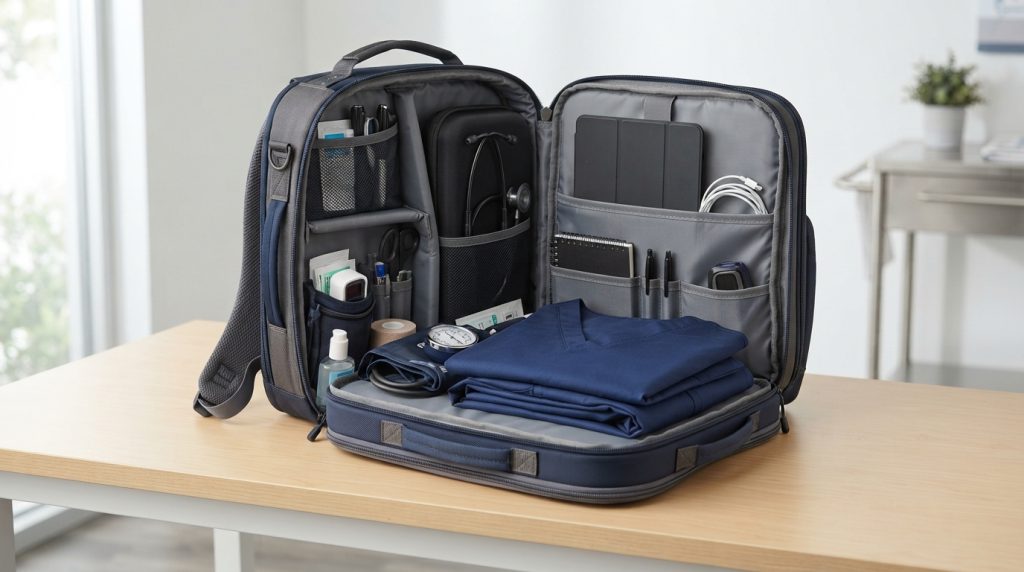
Consider:
- Main compartment volume
- Number of internal compartments
- Laptop or tablet sleeve
- Small-item organization
- Exterior access pockets
- Equipment protection
- Shoulder strap design
- Back padding
- Weight of the empty bag
- Closure system
- Cleaning requirements
A backpack that is physically large but poorly organized can be less useful than a smaller bag with better compartment design.
How Many Compartments Should a Medical Backpack Have?
There is no ideal number of compartments.
The useful number depends on what is being transported.
Too few compartments can result in:
- Equipment becoming mixed together
- Small objects disappearing
- Cables tangling
- Personal items pressing against work equipment
Too many compartments can create the opposite problem.
Unused pockets can add:
- Weight
- Bulk
- Complexity
A Practical Compartment System
For many users, a three-zone structure can work well:
- Main equipment compartment
- Small accessory organization
- Personal or electronic compartment
Additional specialized sections can be useful when the equipment requires them.
What Should Go in the Main Compartment?
The main compartment should hold larger items that do not need immediate access.
Depending on the role, these might include:
- Folded clothing
- Books
- Larger approved equipment
- Documents
- Equipment cases
Avoid putting small loose accessories at the bottom of a deep compartment.
They can become difficult to find and may be damaged by heavier items placed above them.
What Should Go in External Pockets?
External pockets are best suited to small items that need frequent access.
Examples may include:
- Pens
- Identification accessories
- Charging cables
- Small notebooks
- Personal keys
- Other lightweight items
External pockets should not be treated as unrestricted storage.
Workplace policies should determine what can be carried outside secured compartments.
Should a Medical Backpack Have a Laptop Compartment?
A padded laptop or tablet compartment can be useful for healthcare professionals and students who regularly carry electronic devices.
It can separate electronics from:
- Stethoscope
- Books
- Cables
- Other equipment
Check the compartment dimensions rather than assuming a backpack marketed as “laptop compatible” will accommodate every device.
Measure:
- Device width
- Device height
- Device thickness
Then compare those measurements with the backpack specifications.
Should Medical Equipment Be Kept Separate From Personal Items?
When practical, separation can improve organization.
For example:
Clinical equipment
- Stethoscope
- Approved diagnostic accessories
- Reference materials
Personal items
- Wallet
- Keys
- Personal electronics
- Personal-care items
Separate compartments reduce unnecessary mixing.
However, equipment that requires specific infection-control handling should follow the relevant workplace procedures rather than simply being placed in a different backpack compartment.
How Should a Medical Backpack Protect Equipment?
Protection starts with organization.
Useful backpack features may include:
- Padded compartments
- Dividers
- Elastic loops
- Secure closures
- Reinforced bottom
- Protective sleeves
The appropriate level of protection depends on what is being transported.
A soft padded compartment may be sufficient for some items, while sensitive equipment may require a dedicated protective case.
Do Not Assume Padding Makes Equipment Safe
A padded backpack can reduce impact from ordinary transport, but it does not automatically protect equipment from:
- Major impact
- Water exposure
- Crushing
- Improper storage
- Chemical exposure
Sensitive equipment should be transported according to its manufacturer’s recommendations.
Why Is a Reinforced Backpack Bottom Useful?
The bottom of a backpack experiences frequent contact with:
- Floors
- Chairs
- Vehicle interiors
- Storage areas
A reinforced or durable bottom can help withstand repeated placement.
It may also provide additional separation between the contents and the surface beneath the bag.
Should a Medical Equipment Backpack Be Water-Resistant?
Water resistance can be useful when equipment needs to be transported outdoors.
Potential situations include:
- Walking between buildings
- Commuting
- Traveling between clinical sites
- Carrying equipment from a vehicle
However, water-resistant does not necessarily mean waterproof.
If an item is particularly sensitive to moisture, use the protective storage method recommended by the equipment manufacturer.
What Materials Are Commonly Used for Medical Backpacks?
Medical and healthcare work backpacks may use materials such as:
- Polyester
- Nylon
- Canvas
- Coated fabrics
- Synthetic blends
Material selection affects:
- Weight
- Durability
- Water resistance
- Cleanability
- Flexibility
- Appearance
Polyester
Polyester can provide a combination of durability and relatively low weight.
Nylon
Nylon is commonly used where abrasion resistance and lightweight construction are priorities.
Canvas
Canvas can provide a structured, traditional feel but may be heavier than some synthetic alternatives.
The specific fabric construction matters as much as the fiber itself.
Is an Easy-to-Clean Backpack Important?
It can be.
Backpacks used regularly around healthcare environments can accumulate:
- Dust
- Dirt
- Surface contamination
- Food particles
- Other debris
The appropriate cleaning method depends on the material and manufacturer instructions.
Look for materials with clearly stated care instructions.
Do not apply disinfectants or cleaning chemicals unless they are compatible with the bag’s material.
Can a Medical Backpack Be Disinfected?
Not every backpack is designed to withstand repeated disinfection.
Before using a disinfectant, check:
- Manufacturer instructions
- Material compatibility
- Facility policy
- Product labeling
Healthcare organizations may have specific procedures for items entering patient-care environments.
CDC’s infection-control guidance emphasizes appropriate cleaning and disinfection of environmental surfaces and reusable equipment according to the item and its intended use. CDC Infection Control and Core Practices
A consumer backpack should not automatically be treated as clinical equipment simply because it carries medical supplies.
How Should a Medical Backpack Be Cleaned?
Follow the manufacturer’s care instructions.
A general maintenance routine can include:
- Empty the backpack completely.
- Remove loose debris.
- Inspect every compartment.
- Follow the manufacturer’s cleaning instructions.
- Allow the bag to dry completely.
- Inspect seams and zippers.
- Return equipment only after the bag is ready for use.
Do not assume that machine washing, bleach, alcohol, or other chemicals are safe for every backpack.
What Makes Backpack Straps Comfortable?
Shoulder straps are especially important when carrying equipment for extended periods.
Look for:
- Adequate width
- Padding
- Adjustable length
- Secure attachment points
- Comfortable edge construction
Narrow straps can concentrate pressure on a smaller area.
Adjustable Straps
Adjustability allows the backpack to sit closer to the body.
A backpack that hangs too low can feel less stable and may shift more during movement.
Chest or Sternum Straps
Some larger backpacks include an optional chest strap.
It can help stabilize the shoulder straps when carrying a larger load.
Whether it is useful depends on the backpack’s design and the user’s preference.
How Should a Medical Backpack Sit on the Back?
The backpack should remain reasonably stable while walking.
A properly adjusted backpack should not:
- Swing excessively
- Hang far below the lower back
- Pull heavily backward
- Require repeated repositioning
Place heavier items closer to the back rather than at the farthest exterior edge of the bag.
This can help keep the load closer to the body’s center.
How Heavy Should a Medical Equipment Backpack Be?
There is no single weight that is appropriate for every person or job.
The total load depends on:
- Backpack weight
- Equipment weight
- Work duration
- Carrying distance
- Individual physical factors
The American Academy of Pediatrics recommends that children’s backpacks generally stay within 15% of body weight, but that guidance is specifically intended for children and should not be automatically applied to adults. American Academy of Pediatrics Backpack Safety Guidance
For adults, the more useful principle is to avoid carrying unnecessary weight and to select a carrying system appropriate to the actual load.
If carrying equipment causes pain, numbness, or other concerning symptoms, the issue should be discussed with an appropriate healthcare professional rather than solved simply by buying a different backpack.
How Can You Reduce Medical Backpack Weight?
Start by removing everything that is not needed.
Empty the backpack completely and separate items into:
- Used daily
- Used occasionally
- Rarely used
- Personal
- Unnecessary
Then reconsider whether occasional equipment needs to travel every day.
A smaller backpack can naturally discourage unnecessary packing.
How Should Equipment Be Arranged Inside the Backpack?
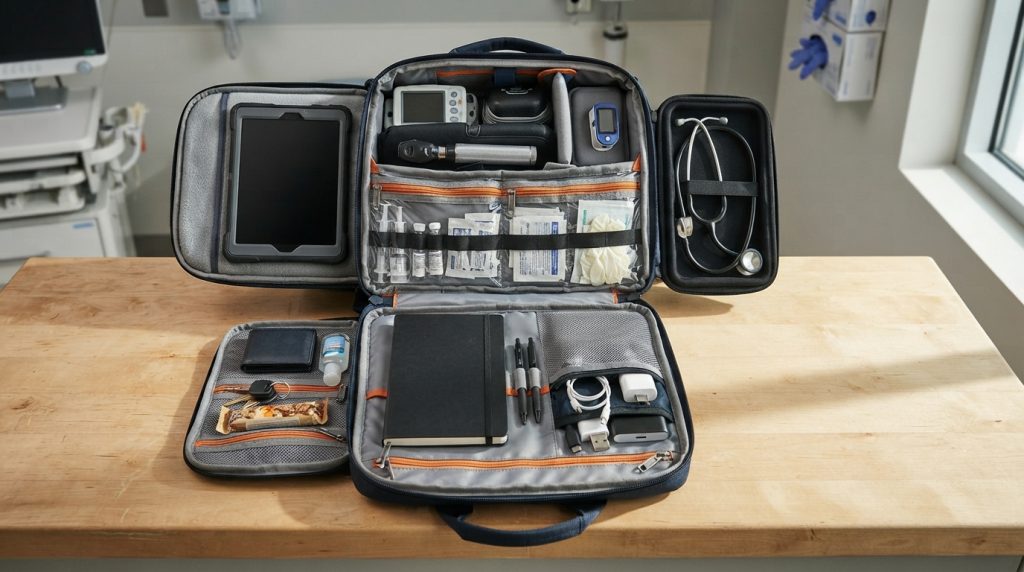
A useful organization strategy is to place equipment according to:
Weight + frequency of use + protection needs.
Heavy Items
Place heavier objects close to the back.
Frequently Used Items
Keep commonly accessed objects in easily reachable compartments.
Fragile Items
Use padded sections or dedicated protective cases.
Small Items
Use organizers or smaller compartments.
Personal Items
Keep them separate from work equipment whenever practical.
This creates a predictable storage system.
Where Should a Stethoscope Go in a Medical Backpack?
A stethoscope should be protected from unnecessary compression and tangling during transport.
Some backpacks provide:
- Dedicated stethoscope sleeves
- Elastic straps
- Padded sections
- Separate instrument compartments
Another option is a dedicated stethoscope carrying case.
A separate case can be particularly useful when the backpack contains books, electronics, or other heavy items.
Should a Stethoscope Be Stored Loose?
Loose storage can allow the instrument to become:
- Tangled
- Compressed
- Bent around other objects
- Difficult to locate
A dedicated compartment or suitable case creates more controlled storage.
Cleaning and handling should follow the stethoscope manufacturer’s instructions and workplace requirements.
Should Medical Backpacks Have Dedicated Equipment Loops?
Loops can help keep smaller tools in consistent locations.
They may be useful for:
- Pens
- Cables
- Small accessories
- Approved diagnostic tools
However, every loop should have a practical purpose.
Too many loops can make a backpack harder to organize rather than easier.
Are Zippers Important on Medical Backpacks?
Yes.
Zippers determine how securely compartments close and how easily contents can be accessed.
Look for:
- Smooth operation
- Secure closure
- Strong stitching
- Appropriate zipper size
- Protected zipper tracks where useful
A zipper that catches repeatedly can become frustrating during daily use.
Are Magnetic Closures Appropriate?
Magnetic closures can provide fast access, but their suitability depends on the contents.
Sensitive equipment or electronic devices may have specific storage requirements.
When carrying specialized equipment, follow the equipment manufacturer’s instructions rather than assuming a magnetic closure is universally appropriate.
Should a Medical Backpack Have a Separate Shoe Compartment?
A separate footwear compartment can be useful for professionals who carry work shoes.
It can help keep footwear separate from:
- Clothing
- Electronics
- Documents
- Personal items
However, not everyone needs this feature.
A separate shoe compartment adds capacity and may increase the size of the backpack.
Can a Medical Backpack Carry Scrubs?
Yes, when the backpack has sufficient capacity.
A larger bag can provide space for a spare scrub set, particularly for professionals who need to carry backup clothing.
The clean clothing should be stored in a manner consistent with workplace procedures.
A backpack used for transporting clean clothing should not automatically be assumed suitable for transporting contaminated garments.
How Can Nurses Organize a Medical Equipment Backpack?
Nurses should first consider what they actually need to transport.
A possible organization system might include:
Main Compartment
- Spare clothing
- Notebook
- Larger approved items
Equipment Section
- Stethoscope
- Protected clinical equipment
Small-Item Section
- Pens
- Identification accessories
- Charging accessories
Personal Section
- Wallet
- Keys
- Personal electronics
The actual contents should follow the nurse’s employer requirements.
The scrub bags for nurses category can also be useful when evaluating different bag formats for healthcare work.
How Should Nursing Students Choose a Medical Backpack?
Students often need to combine academic and clinical equipment.
A practical backpack may need room for:
- Laptop
- Tablet
- Textbooks
- Notebook
- Stethoscope
- Clinical accessories
- Personal belongings
Prioritize Separation
A dedicated electronics section can prevent devices from becoming mixed with heavier objects.
A separate equipment compartment can keep clinical tools easier to locate.
Consider the Commute
Students who travel by:
- Car
- Bus
- Train
- Bicycle
- Walking
may have different requirements.
The backpack should be evaluated based on the complete daily routine rather than the classroom alone.
How Should Medical Students Choose a Backpack?
Medical students may carry substantial academic materials in addition to clinical equipment.
Look for:
- Laptop sleeve
- Large central compartment
- Stethoscope storage
- Small-item organizers
- Comfortable shoulder straps
- Durable bottom
- Water-resistant exterior where useful
A backpack with too many specialized medical compartments may be unnecessary if most of the contents are books and electronics.
How Should Physicians Choose a Medical Equipment Backpack?
Physicians may prefer a smaller, more streamlined backpack when most clinical equipment is already available at the workplace.
Potential priorities include:
- Laptop protection
- Document storage
- Stethoscope compartment
- Personal-item section
- Professional appearance
- Comfortable commuting
The correct capacity should reflect actual daily equipment rather than a hypothetical emergency load.
How Should Mobile Healthcare Professionals Choose a Backpack?
Professionals who travel between locations may need more capacity and more organization.
Consider:
- Larger main compartment
- Multiple equipment sections
- Water resistance
- Comfortable straps
- Durable construction
- Easy-access exterior pockets
- Separate personal storage
When equipment travels between multiple environments, cleaning and handling procedures become particularly important.
How Should Veterinary Professionals Choose a Medical Backpack?
Veterinary environments can involve different equipment and environmental conditions.
A suitable backpack may need:
- Durable construction
- Easy-access organization
- Secure closures
- Cleanable materials
- Separate storage for personal belongings
Animal-care environments can expose bags to dirt, fur, and other debris, so material maintenance can be an important consideration.
What Is the Difference Between a Medical Backpack and a Regular Backpack?
The distinction is primarily based on intended organization and features.
A standard backpack may provide:
- Main compartment
- Laptop sleeve
- Basic accessory pockets
A medical equipment backpack may provide additional:
- Equipment organization
- Protective compartments
- Instrument loops
- Dedicated healthcare-equipment storage
- More structured interior design
However, a regular high-quality backpack can sometimes meet a healthcare professional’s needs.
The correct choice depends on the equipment rather than the label.
Can a Regular Backpack Carry Medical Equipment?
Yes, provided it safely accommodates the equipment and complies with workplace requirements.
For simple loads such as:
- Stethoscope
- Tablet
- Notebook
- Personal items
a conventional backpack may provide sufficient organization.
Specialized backpacks become more useful as equipment volume and protection requirements increase.
What Should You Look for in a Medical Equipment Backpack for Travel?
Travel introduces additional considerations.
Look for:
- Secure closures
- Comfortable straps
- Durable construction
- Adequate capacity
- Separate electronics storage
- Compact organization
- Easy access
- Water resistance where appropriate
If traveling by air, also consider how the backpack fits within applicable airline personal-item or carry-on dimensions.
Airline requirements vary, so check the carrier’s current baggage rules before traveling.
Should Medical Equipment Backpacks Be Lockable?
A lockable zipper or compatible luggage lock can add security during transportation.
However, a lock does not replace appropriate workplace storage procedures.
Sensitive equipment, confidential materials, or restricted items should be handled according to the applicable organization’s policies.
Should a Medical Backpack Be Waterproof?
Complete waterproofing is usually unnecessary for ordinary commuting.
Water resistance may be sufficient for:
- Light rain
- Short outdoor walks
- Everyday commuting
Sensitive equipment should have additional protection when required.
A waterproof exterior does not guarantee that every zipper, seam, or compartment is waterproof.
How Should Medical Backpacks Be Stored Between Shifts?
When possible:
- Empty unnecessary items
- Remove food
- Remove personal trash
- Inspect for damage
- Clean according to manufacturer instructions
- Store equipment appropriately
- Keep the bag in an approved location
Do not leave sensitive equipment inside a backpack indefinitely if the manufacturer or workplace specifies another storage method.
What Are the Most Common Medical Backpack Problems?
Too Much Capacity
A huge backpack can encourage unnecessary weight.
Poor Organization
A large central compartment without internal organization can make equipment difficult to locate.
Uncomfortable Straps
Poorly padded or narrow straps can make heavier loads less comfortable.
Insufficient Protection
Loose equipment can collide inside the bag.
Difficult Cleaning
Some materials are not designed for frequent cleaning.
Weak Zippers
Frequent daily use can expose weak hardware quickly.
Poor Weight Distribution
Heavy items placed far from the back can make a backpack feel less stable.
Excessive External Pockets
Additional pockets are useful only when they serve a real purpose.
How Can You Test a Medical Equipment Backpack Before Buying?
Do not evaluate the backpack empty.
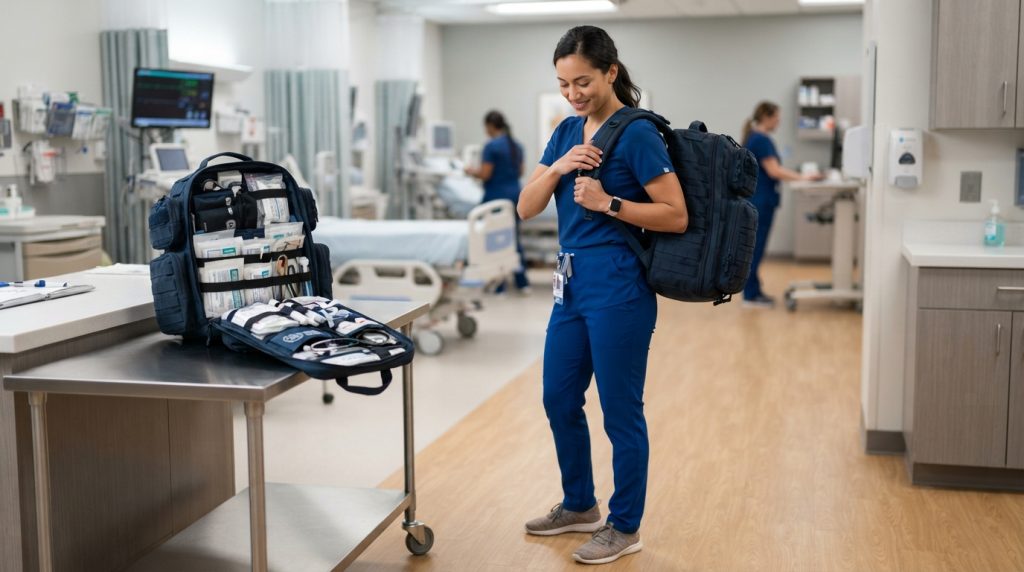
Load it with the equipment normally carried during a workday.
Step 1: Load the Main Equipment
Add:
- Stethoscope
- Books
- Electronics
- Approved clinical accessories
Step 2: Add Personal Items
Include the items normally carried during the commute.
Step 3: Adjust the Straps
Set the backpack so it sits comfortably against the back.
Step 4: Walk
Check whether the backpack swings or shifts.
Step 5: Sit
Make sure the bag does not interfere with the chair or posture.
Step 6: Open Common Compartments
Test whether frequently used items are easy to reach.
Step 7: Check the Weight
Ask whether everything inside actually needs to travel every day.
How Should You Choose a Medical Backpack Online?
When shopping for medical equipment backpacks, review the specifications rather than relying solely on product photographs.
Check:
- Overall dimensions
- Empty weight
- Capacity
- Compartment dimensions
- Laptop compatibility
- Material
- Padding
- Strap construction
- Cleaning instructions
- Warranty
- Return policy
Check Internal Dimensions
External dimensions can be misleading.
A thickly padded backpack may have less usable interior space than its external measurements suggest.
If carrying a specific piece of equipment, compare its dimensions directly with the relevant compartment.
Should You Buy a Large Backpack or Several Smaller Bags?
This depends on the work routine.
One Large Backpack
Potential advantages:
- One carrying system
- Centralized organization
- Hands-free transport
Potential disadvantages:
- Greater total weight
- More temptation to overpack
- Larger physical footprint
Several Smaller Bags
Potential advantages:
- Modular organization
- Easier separation
- Smaller individual loads
Potential disadvantages:
- More items to carry
- More opportunities to misplace something
- Less convenient for commuting
For many professionals, one appropriately sized backpack combined with smaller protective cases can provide a practical balance.
When Should a Medical Equipment Backpack Be Replaced?
Inspect the backpack regularly for:
- Broken zippers
- Torn seams
- Damaged straps
- Frayed fabric
- Broken buckles
- Loss of padding
- Water-resistant coating deterioration
- Deformed compartments
A backpack should also be reconsidered if its organization no longer matches the equipment being carried.
A growing equipment load may require a different configuration.
Conversely, a smaller bag may be more practical if the current backpack is consistently half empty.
Medical Equipment Backpack Buying Checklist
Capacity
- Holds all required daily equipment
- Does not encourage unnecessary overpacking
- Main compartment is appropriately sized
- Internal space is actually usable
Organization
- Frequently used items are easy to reach
- Small accessories have dedicated storage
- Electronics have appropriate protection
- Work and personal items can be separated
Protection
- Sensitive equipment has adequate padding
- Heavy objects do not crush fragile items
- Equipment cases fit properly
- Closures remain secure
Comfort
- Shoulder straps are adjustable
- Straps are sufficiently padded
- Backpack sits securely against the back
- Weight feels balanced when fully loaded
Durability
- Seams appear secure
- Zippers operate smoothly
- Bottom construction is durable
- Hardware feels appropriate for regular use
Maintenance
- Cleaning instructions are available
- Material suits the intended environment
- The backpack can be maintained according to workplace requirements
Work Compatibility
- Workplace policies permit the bag
- Equipment can be transported appropriately
- Required cleaning procedures can be followed
- The backpack does not interfere with clinical activities
Conclusion
A medical equipment backpack should be selected around the equipment and work routine rather than simply its advertised capacity.
The most useful features generally include:
- Appropriate capacity
- Practical compartments
- Equipment protection
- Comfortable straps
- Durable construction
- Easy organization
- Appropriate cleaning and maintenance
A large backpack can be valuable for professionals who carry substantial equipment, but larger does not automatically mean better. Excess capacity can become excess weight when every compartment gets filled.
The best approach is to identify what needs to travel every day, determine which items need protection or quick access, and then select a backpack that accommodates those requirements without unnecessary bulk.
For healthcare professionals, organization is ultimately the purpose of the backpack. The right design keeps essential equipment protected, accessible, and easier to transport throughout the workday.
Frequently Asked Questions
What is the best size for a medical equipment backpack?
The appropriate size depends on the equipment being carried. A smaller backpack may be enough for a stethoscope, tablet, notebook, and personal items, while mobile healthcare professionals may need a larger design with multiple equipment compartments.
What should a medical equipment backpack have?
Useful features can include padded equipment compartments, adjustable shoulder straps, durable construction, organized pockets, secure closures, and sufficient capacity for the intended equipment. Laptop or tablet storage can also be useful for healthcare students and professionals.
Are medical equipment backpacks waterproof?
Some are water-resistant, but water resistance and waterproofing are different. A water-resistant backpack can help with light rain and everyday commuting, while moisture-sensitive equipment may require additional protection according to its manufacturer’s instructions.
Can nurses use medical backpacks?
Yes. Nurses may use backpacks to transport approved work equipment, educational materials, personal items, or spare clothing, depending on their workplace requirements. The contents and storage method should follow employer policies.
Should a stethoscope have its own compartment?
A dedicated compartment or protective case can help prevent a stethoscope from becoming tangled, compressed, or damaged by heavier objects. A separate case may be particularly useful when a backpack also contains books or electronics.
How do you organize a medical equipment backpack?
Separate items according to frequency of use, weight, and protection requirements. Place heavier objects closer to the back, frequently used items in accessible pockets, fragile equipment in padded sections, and personal belongings in separate compartments when practical.
Can a regular backpack be used for medical equipment?
Yes, if it provides adequate protection, organization, capacity, and comfort for the equipment being carried. A specialized medical backpack becomes more useful when dedicated equipment compartments or additional protection are needed.
How should a medical equipment backpack be cleaned?
Follow the manufacturer’s care instructions. Empty the backpack, remove loose debris, clean it using approved methods, allow it to dry completely, and inspect the seams and closures before returning equipment to it.