

A clinical workspace can feel comfortable at the beginning of a shift and noticeably cooler a few hours later. Air-conditioned treatment rooms, early-morning starts, and long periods spent moving between departments can make an additional clothing layer useful. However, not every jacket works well over a medical uniform. Bulky sleeves, restrictive shoulders, inconvenient closures, and poorly positioned pockets can make an otherwise practical garment frustrating to wear.
Choosing the right scrub jackets means considering how the garment fits over a scrub top, whether it allows unrestricted movement, and how its fabric and features suit the working environment. Nurses, physicians, medical assistants, dental professionals, veterinary staff, and healthcare students may have different preferences, but each benefits from evaluating comfort, functionality, and workplace requirements before purchasing.
The most useful scrub jacket is not necessarily the thickest or most feature-heavy option. It is the one that provides appropriate coverage, fits comfortably over the uniform, and supports the tasks performed throughout the workday.
Quick Answer
The best healthcare scrub jacket provides comfortable layering, adequate shoulder and arm movement, practical pockets, suitable closures, and fabric that meets the wearer’s needs. Zip-front warm-up jackets are useful for adjustable coverage, while different collar, cuff, and hem designs offer different fits and appearances.
Before buying a scrub jacket, evaluate:
- Fit: Enough room to wear the jacket over a scrub top without pulling across the shoulders or chest.
- Fabric: Appropriate weight, flexibility, durability, and care requirements.
- Closure: A zipper, snaps, or another fastening system that is easy to use.
- Pockets: Convenient storage without excessive bulk.
- Sleeves and cuffs: Comfortable construction that does not restrict movement.
- Length: Coverage appropriate for the wearer and intended use.
- Workplace policy: Whether the jacket is permitted in the relevant clinical area and whether separate protective clothing is required.
Key Takeaways
- A scrub jacket should fit over the intended uniform without restricting movement.
- Lightweight warm-up jackets and more structured designs serve different preferences.
- Shoulder construction, sleeve length, cuffs, and closures affect everyday comfort.
- Pockets should support actual work needs rather than add unnecessary bulk.
- Fabric weight and layering should suit the work environment.
- Men’s and women’s jacket patterns may differ, so sizing and fit descriptions matter.
- Ordinary scrub jackets worn for comfort are not substitutes for required personal protective equipment.
- Manufacturer care instructions and workplace policies should guide maintenance and use.
1. Understand the Different Types of Healthcare Scrub Jackets
Scrub jackets are available in several styles, each offering a different combination of coverage, fit, and functionality. Understanding these differences helps narrow the options before considering fabric, color, and sizing.
Zip-Front Warm-Up Jackets
Zip-front jackets have a front zipper that allows the wearer to put the garment on or remove it without pulling it over the head.
This design may suit professionals who want an adjustable layer during a shift. It can also make the jacket convenient to wear over different scrub tops.
Potential advantages include:
- Easy on-and-off access.
- Adjustable front opening.
- Compatibility with many scrub uniform styles.
- Convenient access to the underlying uniform.
- Availability in different sleeve and pocket configurations.
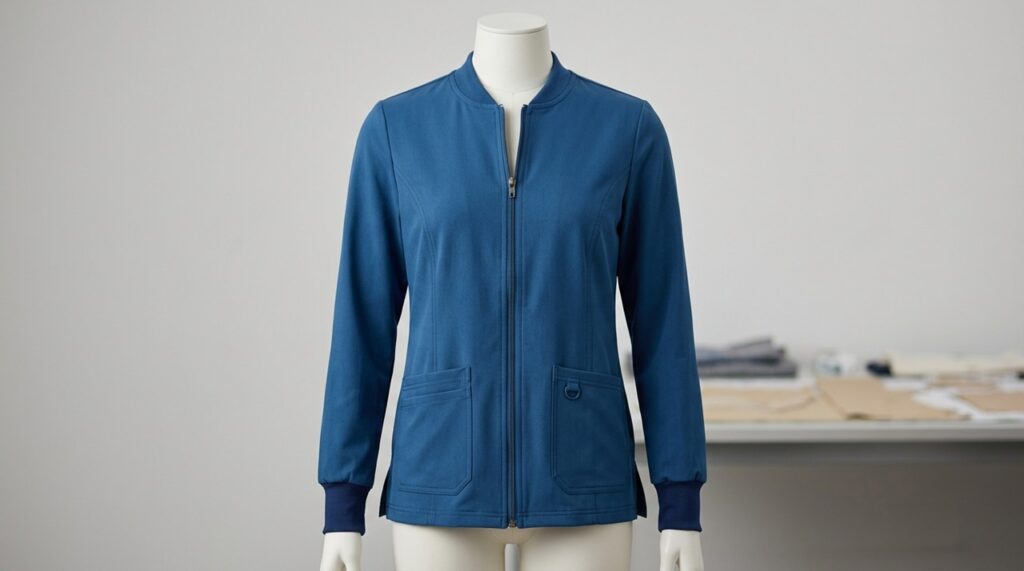
For example, the Women’s Warm-Up Zip Jacket | 5061 features a front zipper, knit collar and cuffs, two front pockets, a shoulder loop, side vents, and a shaped lower hem. These details illustrate how a warm-up jacket can combine coverage with practical features.
Crew-Neck Zip Jackets
Crew-neck zip jackets combine a rounded neckline with a front zipper. Depending on the design, they may also feature ribbed or knit cuffs and a more shaped silhouette.
This construction can provide a neat appearance while allowing the wearer to adjust the front opening.
When evaluating a crew-neck jacket, check whether the neckline feels comfortable when fully zipped. The collar should not press against the neck or interfere with an underscrub layer.
Traditional Warm-Up Jackets
Traditional warm-up jackets may have a more relaxed silhouette and straightforward construction.
They can suit professionals who prioritize a familiar uniform appearance and uncomplicated layering. However, the actual fit varies by manufacturer and collection.
Check the garment’s shoulder width, sleeve length, and body length rather than assuming every warm-up jacket follows the same pattern.
Knit-Panel and Stretch Jackets
Some jackets use knit collars, cuffs, hems, or stretch panels to create a flexible fit.
These features may help the garment accommodate everyday movements, depending on the fabric and construction. They can also affect how closely the jacket sits around the wrists, waist, and neckline.
Consider whether the knit sections remain comfortable during reaching, bending, and other normal tasks.
Shaped or Tailored Jackets
Some women’s scrub jackets use shaped seams to create a more defined silhouette.
For example, the Women’s Zip Jacket | 4812 includes front and back princess seams, ribbed neck and sleeve details, two front pockets, a zippered phone pocket, and side slits.
A shaped design may appeal to professionals who prefer a less boxy fit. However, a tailored silhouette should still allow sufficient room over the scrub top and through the shoulders and upper back.
2. Choose a Jacket That Fits Comfortably Over Scrubs
A scrub jacket should be evaluated as an additional layer, not as a standalone top. A garment that fits well over a thin undershirt may feel restrictive when worn over a scrub top with a more substantial fabric.
The best fit allows comfortable movement while maintaining an appropriate professional appearance.
Check the Shoulders and Upper Back
The shoulders and upper back experience considerable movement during reaching, lifting, and bending.
When trying on a jacket, raise both arms overhead, reach forward, and cross your arms across your chest. The fabric should not pull excessively across the back or restrict shoulder movement.
Pay attention to the shoulder seams. Their position affects how the sleeves hang and how the garment sits over the underlying uniform.
Evaluate Chest and Torso Room
The jacket should close comfortably over the scrub top without pulling around the chest or abdomen.
At the same time, excessive fabric can create bulk around the torso and pockets.
If you intend to wear the jacket zipped, test the fit with the zipper closed. If you prefer wearing it open, make sure the front panels sit comfortably without catching on other clothing or equipment.
Check Sleeve Length
Sleeves should provide the intended coverage without obstructing normal movement.
Consider whether the cuffs remain comfortable when reaching forward, bending the elbows, or working at a counter. Sleeves that are too long may interfere with tasks, while short sleeves may not provide the coverage you want.
Test the Jacket While Sitting and Standing
A jacket that looks suitable while standing may fit differently when sitting or leaning forward.
Check whether the hem rides up, the zipper presses against the body, or the shoulders become restrictive. These simple movements can reveal fit issues before a purchase.
Avoid Oversizing as the Only Solution
Choosing a larger size may create additional room, but it can also result in excessively long sleeves, dropped shoulders, or bulky pockets.
If a jacket feels tight in one area but loose in another, consider whether a different cut or design would provide a better overall fit.
3. Select Fabric for the Working Environment
Fabric influences how a scrub jacket feels, moves, and holds its shape. The most suitable material depends on the intended use, the underlying uniform, and the temperature of the work environment.
Polyester Blends
Polyester is commonly used in healthcare apparel because it can contribute to durability and shape retention.
Depending on the blend and construction, polyester-based jackets may also provide wrinkle resistance and relatively straightforward care.
However, polyester garments do not all feel the same. Fabric weight, weave, finishing, and the addition of other fibers influence texture and flexibility.
Stretch Blends
Some scrub jackets contain spandex or elastane, while others incorporate stretch through fabric construction.
Stretch may help a jacket accommodate movement around the shoulders, back, and arms. It can be useful for professionals who regularly reach, bend, or move equipment.
However, stretch does not compensate for an incorrect size. The garment must still provide adequate room over the underlying uniform.
Knit Details
Knit cuffs, collars, and hems can create a different feel from woven or conventional fabric sections.
These details may help the jacket sit closer to the body at the wrists or neckline. Their comfort depends on the construction and how tightly they fit.
If you prefer a looser cuff or a more structured collar, compare those details before choosing a style.
Lightweight Fabrics
Lightweight jackets may be preferable when only a modest additional layer is needed.
They can be easier to wear over a scrub top without creating unnecessary bulk. The appropriate weight depends on the environment, activity level, and personal comfort.
Consider the Complete Layering System
A jacket is only one part of the clothing combination.
A thick scrub top, long-sleeve underscrub, and heavy jacket may create more warmth and bulk than necessary. Conversely, a very lightweight jacket may not provide the level of coverage you want in a cool room.
Choose the combination based on the actual working conditions rather than assuming a heavier garment is always better.
4. Evaluate Closures, Cuffs, and Other Construction Details
Small construction details can affect how a jacket performs during everyday work.
Zippers
A front zipper makes a jacket easy to open and close. Before purchasing, consider whether the zipper operates smoothly and whether its position remains comfortable when the garment is fully closed.
A zipper should not create uncomfortable pressure against the neck or abdomen. If you frequently wear the jacket open, check that the front panels hang neatly.
Knit Cuffs
Knit cuffs can help sleeves stay positioned around the wrists.
The cuff should provide enough hold without feeling tight. If it presses against the skin or restricts movement, another design may be more comfortable.
Side Vents
Side vents are openings near the lower hem that provide additional room around the hips.
They can help a jacket move more comfortably when sitting, bending, or reaching. Their usefulness depends on the jacket’s length and overall cut.
Shoulder Loops and Utility Details
Some jackets include loops or attachment points near the shoulder seam.
These details may support specific accessories, but their usefulness depends on the items you carry and the requirements of your role. Do not assume every loop or attachment is necessary for everyday work.
Seams and Stitching
Inspect the stitching around the shoulders, underarms, pockets, cuffs, and zipper.
These areas experience repeated movement and handling. Secure construction can help a garment withstand regular wear, although the actual lifespan also depends on fabric quality, laundering, and frequency of use.
5. Choose Pockets That Support Your Work
Pockets can make a scrub jacket more useful, particularly when a professional needs to carry small essentials throughout a shift.
The most suitable pocket arrangement depends on what you carry and how often you need access to it.
Front Pockets
Front pockets provide convenient storage for small items.
Check their position and depth. A pocket that sits too high, too low, or too close to the zipper may be less convenient than one positioned to suit your natural hand movement.
Zippered Pockets
A zippered pocket can help secure selected items while walking or bending.
For example, the Women’s Zip Jacket | 4812 includes a zippered phone pocket alongside its front pockets. This configuration may be useful for someone who wants a separate compartment for a personal device.
Before relying on any pocket for an item, confirm that its dimensions and closure suit that purpose.
Utility Loops
A utility loop can provide a place to attach a compatible accessory when permitted by the workplace.
However, loops and other attachments should not interfere with patient care, protective equipment, or movement. Use them only for appropriate items.
Avoid Overloading the Jacket
Heavy or overfilled pockets can pull on the fabric and affect the way the jacket hangs.
Think about which items you genuinely need to carry. If most essentials fit better in scrub pant pockets, there may be no need to select a jacket with numerous compartments.
6. Match the Jacket to Your Healthcare Role
Different roles create different needs for coverage, movement, and storage. The right jacket should support the work being performed without conflicting with the facility’s uniform policy.
| Healthcare Role | Features Worth Considering | Main Consideration |
| Nurses | Comfortable fit, practical pockets, easy closure | Frequent movement and access to essentials |
| Physicians | Appropriate fit, professional appearance, easy layering | Workplace dress code and daily tasks |
| Medical assistants | Lightweight construction, functional pockets | Versatility across routine responsibilities |
| Dental professionals | Comfortable sleeves and suitable coverage | Procedure-specific clothing requirements |
| Veterinary professionals | Mobility, secure fit, practical construction | Task-specific exposure and protective clothing |
| Healthcare students | Approved colors, simple styling, appropriate sizing | School and clinical-site policies |
These are general considerations rather than strict rules. The actual requirements of the workplace should guide the final decision.
For Professionals Who Move Frequently
If your work involves reaching, bending, and moving between rooms, prioritize shoulder mobility, sleeve comfort, and a secure fit.
A jacket that is easy to remove may also be useful when conditions change during the day.
For Professionals Who Prefer a Structured Appearance
A shaped jacket with defined seams may provide the silhouette you prefer.
Check that the tailored construction does not restrict the chest or upper back. A professional appearance should not come at the expense of comfortable movement.
For Students and Clinical Trainees
Students should confirm whether additional jackets are permitted and whether a particular color or style is required.
Some programs have specific uniform requirements, and clinical facilities may impose additional rules. Confirm these details before purchasing a jacket for regular clinical use.
7. Understand the Difference Between a Scrub Jacket and Protective Apparel
A scrub jacket worn for comfort or identification should not be confused with clothing designed to provide protection against occupational hazards.
The distinction matters because healthcare professionals may encounter blood, body fluids, chemicals, or other potentially hazardous materials depending on their responsibilities.
The CDC explains that ordinary clinical or laboratory coats and jackets worn over clothing for comfort or identity are not considered personal protective equipment. It also emphasizes that protective clothing should be selected according to the anticipated exposure and the task being performed.
When a Standard Scrub Jacket Is Appropriate
A standard scrub jacket may be suitable as an additional clothing layer where workplace policy permits it.
Its role is generally to provide coverage, comfort, or a particular uniform appearance rather than to serve as a validated protective barrier.
When Protective Clothing Is Required
Some tasks require designated protective apparel, such as an isolation gown or another garment selected for the anticipated exposure.
The CDC’s infection-control recommendations for healthcare settings explain how protective equipment is selected according to patient interaction and the potential for exposure to infectious material.
An ordinary scrub jacket should never replace required protective clothing.
Check the Facility’s Policy
Requirements can vary by department, procedure, and workplace.
Before wearing a jacket during patient care, determine whether it is permitted in that setting, whether it must be removed for particular tasks, and whether separate protective equipment is required.
8. Choose Colors That Work With Your Uniform
Color is often an important consideration when choosing a scrub jacket. Healthcare facilities and training programs may assign specific colors to departments, roles, or student groups.
A jacket that looks suitable with a uniform may not meet the facility’s exact requirements.
Before purchasing, confirm:
- Whether the jacket must match the scrub top and pants.
- Whether contrast panels or trims are permitted.
- Whether the garment needs to be a specific color.
- Whether embroidery or identification is required.
- Whether the jacket style is approved for the intended setting.
Color can appear different under various lighting conditions or on different screens. If matching an existing uniform is important, review the manufacturer’s listed color and compare it with the applicable uniform guidance.
9. Choose the Right Size When Shopping Online
Online shopping makes it convenient to compare jacket styles and available colors, but sizing deserves careful attention.
A jacket’s size label does not guarantee that it will fit the same way as another garment from the same brand. Different collections may use different shoulder widths, sleeve lengths, and body proportions.
Check Your Measurements
Review the manufacturer’s size chart and compare it with your measurements.
Useful details may include:
- Chest measurement.
- Shoulder width, if provided.
- Sleeve length.
- Body length.
- Fit description.
Not every product listing provides all these measurements, so use the available specifications for the exact garment.
Consider the Uniform Beneath the Jacket
When possible, try the jacket over the scrub top you intend to wear with it.
This helps establish whether the garment provides sufficient room through the shoulders and chest. It also reveals whether the sleeves bunch up or the jacket becomes too tight when zipped.
Review the Return Policy
Before purchasing an unfamiliar style, check the return and exchange conditions.
Trying one jacket before buying several can help confirm whether the fit, fabric, and features meet your needs.
Once you find a suitable option, keep a record of the brand, collection, size, and color to make future purchases easier.
10. Care for Scrub Jackets Properly
Regular laundering can affect fabric appearance, color, stitching, and closures over time. Proper care helps maintain the garment’s condition.
The correct method depends on the jacket’s fabric composition and construction, so follow the manufacturer’s instructions.
Useful practices include:
- Check the care label before washing.
- Close zippers and fasteners when recommended.
- Separate colors when appropriate.
- Use the recommended washing temperature.
- Avoid excessive heat if the fabric instructions advise against it.
- Check pockets before laundering.
- Inspect cuffs, seams, and closures regularly.
Pay particular attention to knit cuffs and waist hems, which may experience repeated stretching during wear.
Handle Potentially Contaminated Clothing Appropriately
If a jacket becomes contaminated during clinical work, follow the facility’s procedures for removing, handling, and laundering the garment.
The CDC’s guidance on healthcare laundry and textiles discusses laundering and the handling of healthcare clothing. Workplace requirements may differ depending on the type of garment and whether it has been exposed to blood or other potentially infectious material.
An ordinary home-laundry routine should not replace specific procedures required for contaminated protective apparel.
11. Common Mistakes to Avoid
Choosing a Jacket That Is Too Tight
A jacket that fits closely over a T-shirt may feel restrictive over a scrub top. Evaluate the fit with the intended base layer.
Assuming a Heavier Jacket Is Always Better
More fabric does not automatically mean greater comfort. Choose a weight appropriate for the work environment and the amount of layering required.
Ignoring Sleeve Length
Long sleeves that interfere with movement can become inconvenient during a shift. Check sleeve length and cuff comfort before purchasing.
Selecting Pockets Without Considering Their Purpose
Extra pockets may create bulk without improving functionality. Choose a layout based on the items you actually carry.
Overlooking Workplace Requirements
A jacket may be comfortable and visually appropriate but still be restricted in certain clinical areas. Confirm the facility’s policy before wearing it during patient care.
Treating a Scrub Jacket as PPE
Ordinary scrub jackets are not automatically protective garments. Use the equipment specified for the task and follow workplace infection-control requirements.
Ignoring Care Instructions
Different fabrics and closures may require different maintenance. Follow the garment’s care label to help preserve its appearance and construction.
12. Healthcare Scrub Jacket Buying Checklist
Use this checklist before making a final decision.
Fit and Movement
- Does the jacket fit comfortably over your scrub top?
- Is there enough room through the shoulders and upper back?
- Can you reach, bend, and sit without restriction?
- Are the sleeves and cuffs comfortable?
Fabric and Construction
- Is the fabric appropriate for the work environment?
- Are the seams and closures well constructed?
- Does the jacket provide the intended level of coverage?
- Are the care requirements manageable?
Functionality
- Are the pockets useful for everyday essentials?
- Is the closure easy to operate?
- Are side vents or knit details helpful for your preferred fit?
- Does the jacket avoid unnecessary bulk?
Workplace Requirements
- Is the color approved?
- Is the style permitted in the intended clinical area?
- Is separate protective clothing required for particular tasks?
- Have you checked the product measurements and return policy?

FAQ
What is the difference between a scrub jacket and a warm-up jacket?
The terms are often used interchangeably in healthcare apparel. Both generally describe an additional clothing layer worn over scrubs. Specific designs vary in fabric, closures, cuffs, pockets, and silhouette, so the product description is more useful than the name alone.
Should a scrub jacket fit tightly or loosely?
A scrub jacket should provide enough room to fit comfortably over the intended scrub top without restricting movement. It should not be so loose that the sleeves, hem, or pockets become cumbersome. Test the fit while reaching, bending, and sitting.
Are scrub jackets suitable for every healthcare setting?
Not necessarily. Some workplaces restrict additional clothing layers in certain clinical areas or require specific protective apparel for particular tasks. Check the applicable dress code and infection-control policies before wearing a standard scrub jacket during patient care.
What fabric is best for a healthcare scrub jacket?
The best fabric depends on the intended use, temperature, and personal preference. Polyester blends may offer durability and shape retention, while stretch blends can support movement. Fabric weight, construction, fit, and care requirements should all be considered.
How do I choose the right scrub jacket size online?
Review the manufacturer’s size chart and compare your measurements with the listed ranges. Consider the fit over your regular scrub top, especially through the shoulders, chest, and sleeves. If the style is unfamiliar, consider ordering one jacket first to evaluate its fit.
Conclusion
Choosing a healthcare scrub jacket involves balancing fit, fabric, coverage, storage, and workplace requirements. A lightweight zip-front jacket may suit someone who needs an easy-to-remove layer, while a shaped design with practical pockets may appeal to a professional who prefers a more defined silhouette. The best option depends on how the garment fits over the uniform and how it performs during everyday movement.
Before purchasing, evaluate the shoulders, sleeves, closure, and pocket placement. Review the size chart, check care instructions, and confirm whether the jacket is permitted in the intended clinical environment. Most importantly, distinguish ordinary workwear from protective apparel and follow the facility’s requirements whenever a task involves potential exposure to infectious material.
Healthcare professionals can begin by reviewing the available scrub jackets and women’s uniform options and comparing the features that matter most for their work. Those who prefer to explore apparel in person can also consult Swift Uniforms’ Waco location for a local starting point. A thoughtful choice can provide a useful additional layer while maintaining comfort, functionality, and professional presentation.
