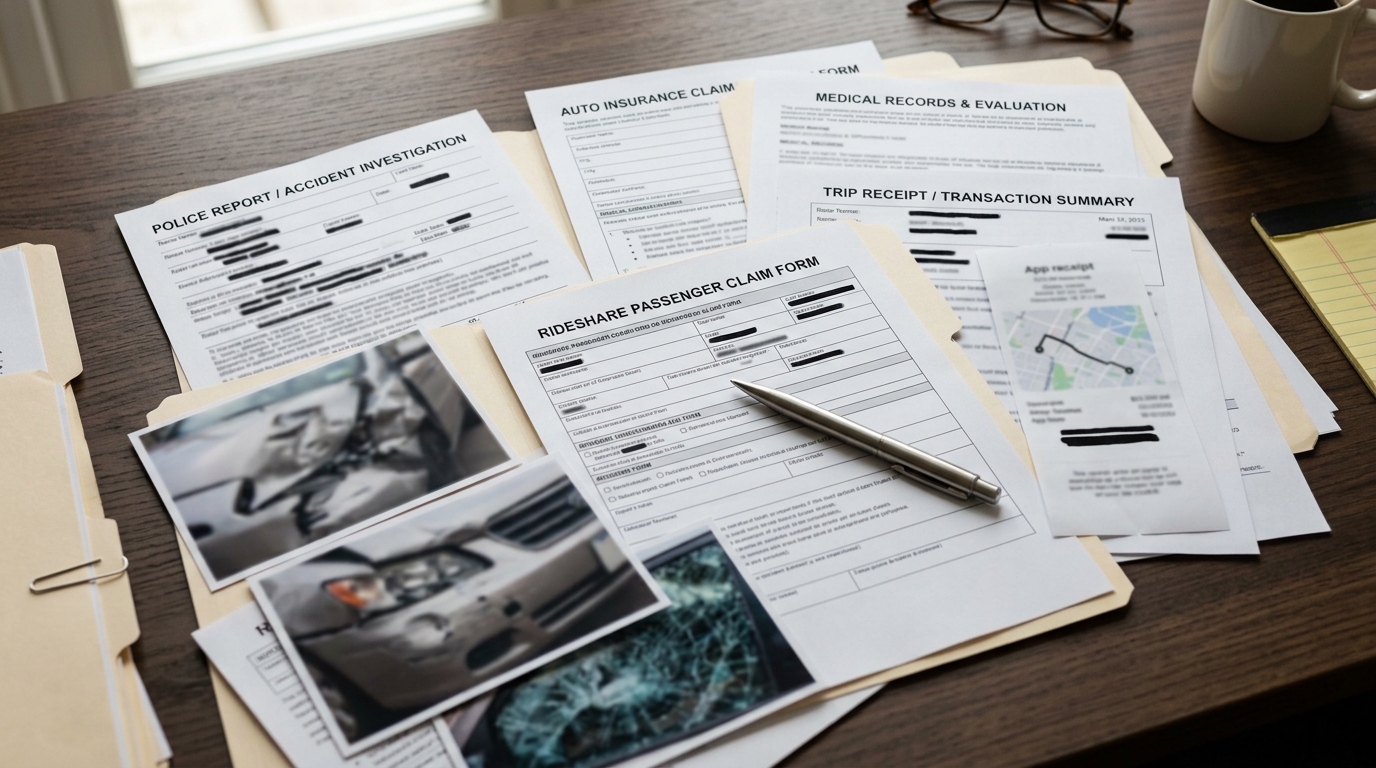
Rideshare passenger injury claims in New York can involve app records, trip status, driver insurance, transportation network company coverage, no-fault benefits, medical records, policy limits, and liability disputes. A passenger may be injured because of the rideshare driver, another driver, a commercial vehicle, a road hazard, or a combination of factors. An Uber and Lyft accident attorney resource can help explain how rideshare insurance, accident evidence, medical documentation, and claim timing are generally evaluated after a crash.
Quick Answer
A rideshare passenger injury claim in New York usually starts by confirming whether the injured person was inside an Uber, Lyft, or other transportation network company vehicle during a prearranged trip. Important evidence may include the app trip receipt, pickup and drop-off details, driver information, screenshots, police report, witness information, vehicle damage photos, medical records, no-fault documents, insurance letters, and communications from the rideshare company. Coverage can depend on trip status, where the trip originated, which vehicle caused the crash, and which insurance policies apply.
Key Takeaways
- Rideshare passenger claims often depend on whether the driver was logged into the app, waiting for a ride, traveling to pick up a passenger, or transporting a passenger.
- New York DFS explains that a transportation network company, or TNC, uses a digital network to connect passengers with drivers who provide prearranged trips. Examples include Uber and Lyft. Department of Financial Services
- DFS explains that New York’s TNC law does not apply to a prearranged trip originating in New York City, but it does apply when a TNC driver picks up a passenger in New York State outside New York City, including trips that end in New York City or outside New York State. Department of Financial Services
- Vehicle and Traffic Law § 1693 requires TNC insurance coverage while the driver is logged onto the TNC digital network and while the driver is engaged in a TNC prearranged trip. NYSenate.gov
- TNC drivers must carry proof of TNC coverage in addition to the insurance identification card required for vehicle registration. Department of Financial Services
- Vehicle and Traffic Law § 1695 requires a TNC and insurer to exchange relevant information after a claim is filed, including the precise times the driver logged on and off the TNC digital network during the 12 hours before and after the accident. NYSenate.gov
- Rideshare passenger claims are evidence-sensitive because app data, driver status, video footage, witness memories, and insurance information can become harder to obtain over time.
What Is a Rideshare Passenger Injury Claim?
A rideshare passenger injury claim may arise when a passenger is injured during a trip arranged through a rideshare app. These claims often involve Uber, Lyft, or another transportation network company that connects passengers with drivers through a digital platform.
A rideshare passenger claim may involve:
- The rideshare driver’s conduct
- Another driver’s negligence
- A hit-and-run driver
- An uninsured or underinsured driver
- A commercial vehicle
- A road hazard
- A defective traffic signal
- A poorly maintained vehicle
- A multi-vehicle crash
- A pedestrian, bicycle, or motorcycle interaction
- No-fault insurance
- Bodily injury coverage
- SUM coverage
- App-based insurance issues
- Medical treatment and lost income
A rideshare passenger should usually preserve both accident evidence and app-based trip evidence.
Why Rideshare Passenger Claims Are Different
A rideshare passenger claim is not always handled like a standard two-car crash. The passenger may not own either vehicle, may not know the drivers, and may not immediately know which insurance policy applies.
These claims may involve:
- Rideshare app trip records
- Driver app status
- TNC insurance
- Personal auto insurance
- Commercial or livery insurance
- No-fault coverage
- Multiple insurers
- Multiple injured people
- Driver employment or independent contractor issues
- Pickup and drop-off location issues
- New York City vs. non-New York City coverage rules
- Company-held data
- Insurance coverage disputes
A car accident attorney resource can help explain why accident evidence, no-fault benefits, bodily injury coverage, and medical records often need to be reviewed together after a motor vehicle crash.
What Is a Transportation Network Company?
New York DFS explains that a transportation network company is a person or entity licensed under Vehicle and Traffic Law Article 44-B that operates in New York State by using a digital network, usually a smartphone app, to connect passengers with drivers who provide prearranged trips. DFS identifies Uber and Lyft as examples of TNCs. Department of Financial Services
This distinction matters because TNC coverage may depend on whether the driver was:
- Logged off the app
- Logged into the app but not on a trip
- On the way to pick up a passenger
- Transporting a passenger
- Completing a prearranged trip
- Operating under a different for-hire vehicle system
The passenger’s claim should confirm the driver’s status at the exact time of the crash.
New York City and Long Island Rideshare Rules
Rideshare coverage can become more complicated when a trip involves New York City. DFS explains that Vehicle and Traffic Law Article 44-B does not apply to a prearranged trip originating in New York City. A vehicle picking up a passenger in New York City must comply with other state and New York City laws and regulations. DFS also explains that Article 44-B applies when a TNC driver picks up a passenger in New York State outside New York City and drops off the passenger in New York City. Department of Financial Services
This can matter for trips involving:
- Long Island pickups
- Nassau County rides
- Suffolk County rides
- Airport rides
- Trips ending in New York City
- Trips beginning in New York City
- Trips crossing county lines
- Trips involving TLC-regulated vehicles
- Trips involving livery or commercial vehicles
The pickup location, trip status, driver licensing, and insurance documents should be reviewed carefully.
Why App Status Matters
The driver’s app status can affect which insurance policy applies. A crash that happens when the driver is logged off may be treated differently from a crash during a prearranged passenger trip.
Common app status categories include:
- Driver logged off
- Driver logged in and waiting for a ride request
- Driver accepted a trip and is going to the pickup
- Passenger is in the vehicle
- Trip is active
- Trip has ended
- Driver is switching between apps
- Driver is using more than one digital network
Vehicle and Traffic Law § 1693 requires insurance that recognizes the driver as a TNC driver and provides financial responsibility coverage while the driver is logged onto the TNC digital network and while the driver is engaged in a TNC prearranged trip. NYSenate.gov
Insurance Coverage During a Rideshare Passenger Trip
When a passenger is inside a rideshare vehicle during an active trip, insurance coverage may differ from ordinary personal auto coverage. New York’s TNC rules require specific financial responsibility coverage for TNC operations outside New York City when the law applies.
Vehicle and Traffic Law § 1693 addresses financial responsibility for TNCs and states that coverage requirements apply while the TNC driver is logged onto the network and while the driver is engaged in a TNC prearranged trip. NYSenate.gov
Insurance review may include:
- TNC group policy
- Driver’s personal auto policy
- Commercial or livery coverage
- No-fault coverage
- Bodily injury liability coverage
- Uninsured motorist coverage
- SUM coverage
- Excess or umbrella coverage
- Coverage exclusions
- Policy limits
- Claim administrator correspondence
The correct coverage path depends on the trip facts, location, policy language, and which driver caused the crash.
TNC Group Insurance Policies
New York Insurance Law § 3455 addresses transportation network company group insurance policies. The statute states that a TNC group policy is a policy where the group policyholder is a TNC and the policy provides insurance to the TNC and group members in accordance with Article 44-B requirements. It also allows group policies to provide limits higher than the minimum requirements and may provide supplementary uninsured/underinsured motorists coverage. NYSenate.gov
A rideshare passenger claim may need to review:
- Group policy information
- Certificate of insurance
- Coverage limits
- Coverage period
- Exclusions
- No-fault coverage
- Liability coverage
- UM or SUM coverage
- Claim administrator contact
- Whether the ride was covered by the TNC policy
The passenger should keep every insurance letter, claim number, and rideshare company response.
Personal Auto Policy Exclusions
A driver’s personal auto policy may not cover all rideshare activity. Vehicle and Traffic Law § 1695 allows motor vehicle insurers in New York to exclude coverage for losses that occur while a TNC driver is logged onto a TNC digital network or while the driver provides a TNC prearranged trip, including liability coverage, no-fault coverage, uninsured motorist coverage, SUM coverage, and physical damage coverage. NYSenate.gov
This is why a claim should not assume the rideshare driver’s ordinary personal auto policy is the only coverage source.
Coverage questions may include:
- Was the driver using the app?
- Was a ride accepted?
- Was the passenger already inside?
- Did the personal insurer deny coverage?
- Did the TNC group policy apply?
- Was the vehicle operating as a TNC vehicle?
- Was the vehicle operating as a livery or TLC vehicle?
- Was another driver at fault?
Coverage disputes should be handled with documentation, not assumptions.
Information TNCs and Insurers May Need to Exchange
Vehicle and Traffic Law § 1695 includes an important claims provision. In a coverage investigation, a TNC and any insurer providing coverage under the article must, within 15 days after a claim is filed, facilitate the exchange of relevant information with directly involved parties and any insurer of the TNC driver if applicable. This includes the precise times the driver logged on and off the TNC digital network in the 12 hours before and after the accident, along with a clear description of coverage, exclusions, and limits. NYSenate.gov
This information can help determine:
- Whether the driver was logged into the app
- Whether the ride was active
- Whether the driver was between rides
- Whether the driver was using multiple apps
- Which policy applies
- What coverage limits may exist
- Whether exclusions may be raised
- Whether the TNC group policy must respond
Passengers should save the trip receipt, claim number, app communications, and any correspondence from insurers.
What to Do After a Rideshare Passenger Accident
A passenger may feel unsure what to do after a rideshare crash because they were not driving and may not know which insurance company applies. The first priority is safety and medical care. After that, evidence should be preserved quickly.
Important steps may include:
- Call 911 if anyone is injured.
- Request medical attention.
- Save the app trip receipt.
- Screenshot the driver’s name and vehicle information.
- Screenshot pickup and drop-off details.
- Get the rideshare driver’s insurance information.
- Get the other driver’s insurance information.
- Photograph vehicle damage.
- Photograph the crash scene.
- Identify witnesses.
- Save messages from the rideshare app.
- Report the crash through the rideshare app.
- Notify the proper no-fault insurer.
- Keep all medical records and bills.
A passenger should not rely only on the app to preserve evidence.
Evidence Needed in a Rideshare Passenger Claim
Rideshare claims require both traditional crash evidence and app-based evidence. A broader guide to evidence for personal injury claims can help explain why reports, photos, records, witness details, and medical documentation often need to support the same timeline.
Useful evidence may include:
- Police report
- DMV MV-104 report
- App trip receipt
- Driver name
- Vehicle make and model
- License plate number
- Pickup and drop-off locations
- Trip start and end time
- App screenshots
- Messages from the driver or app company
- Photos of vehicle damage
- Scene photos
- Witness names
- Dashcam footage
- Surveillance video
- Medical records
- Medical bills
- Work restriction notes
- Lost wage records
- No-fault documents
- Insurance letters
- Claim numbers
The more complete the file, the easier it may be to identify coverage and respond to insurance disputes.
Police Reports and Crash Reports
A police report can help document the crash date, location, vehicles, drivers, passengers, injuries, insurance information, witness names, statements, citations, and apparent contributing factors.
New York DMV’s MV-104 crash report form states that crashes in New York must be reported within 10 days when they cause a fatality, personal injury, or more than $1,000 in damage to the property of any one person. New York DMV MV-104
Useful report details may include:
- Accident date and time
- Exact location
- Vehicle information
- Driver information
- Passenger injury notation
- Insurance information
- Witness names
- Crash diagram
- Officer narrative
- Citations issued
- Apparent contributing factors
- Weather and road conditions
If the report does not show the passenger’s injury clearly, medical records and other evidence may help complete the timeline.
App Records and Trip Screenshots
App records may be central in a rideshare passenger claim. They can help prove that the injured person was a passenger, show the timing of the ride, identify the driver, and help determine insurance coverage.
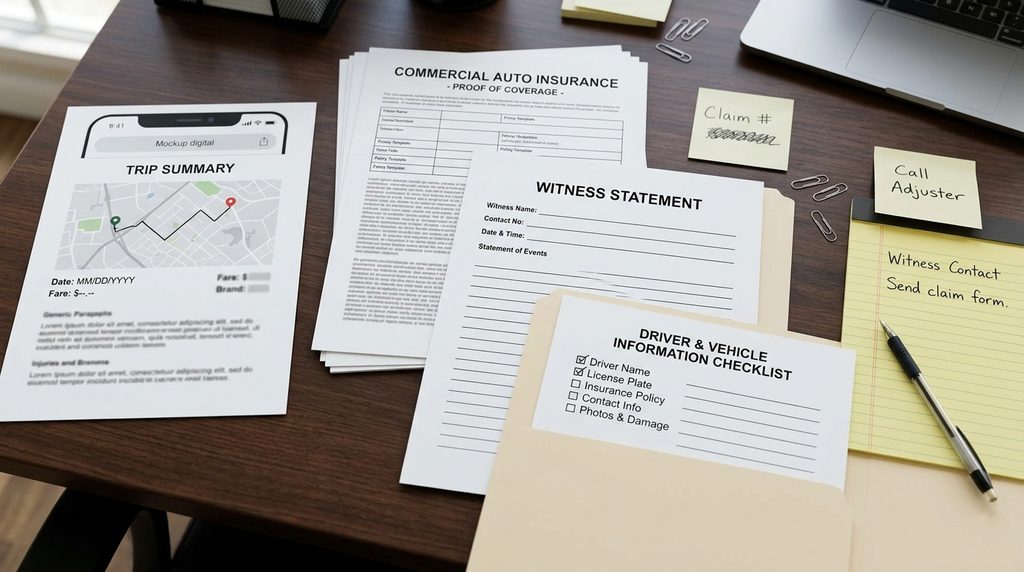
Useful app evidence may include:
- Trip receipt
- Driver name
- Driver photo, if available
- Vehicle make and model
- License plate
- Pickup location
- Drop-off location
- Route map
- Trip time
- Fare receipt
- Email confirmation
- In-app messages
- Support ticket numbers
- App crash report
- Refund or incident messages
Screenshots should be taken early because app screens may change, disappear, or become harder to access later.
Medical Records and Injury Documentation
Medical records help connect the crash to the injuries. They also show treatment, diagnosis, symptoms, restrictions, recovery progress, and future care needs.
Important medical records may include:
- Ambulance records
- Emergency room records
- Hospital records
- Urgent care records
- Primary care records
- Orthopedic records
- Neurology records
- Imaging reports
- Physical therapy notes
- Chiropractic records
- Pain management records
- Prescription records
- Work restriction notes
- Surgical records, when applicable
- Future care recommendations
The claim may become harder to prove if medical treatment is delayed, symptoms are not reported clearly, or records do not connect the injury to the rideshare crash.
No-Fault Benefits for Rideshare Passengers
New York no-fault benefits may cover certain economic losses after many motor vehicle accidents, regardless of who caused the crash. These benefits may help with medical expenses, lost earnings, prescription costs, transportation to medical appointments, and other reasonable and necessary expenses.

No-fault benefits may cover:
- Emergency care
- Hospital bills
- Doctor visits
- Diagnostic testing
- Physical therapy
- Chiropractic care
- Prescription medication
- Lost earnings
- Transportation to medical care
- Certain accident-related expenses
A broader guide to the New York no-fault insurance system can help explain how first-party benefits, medical bill submissions, wage claims, and insurance timing may work after a crash.
No-Fault Notice Deadlines
New York no-fault written notice generally must be submitted as soon as reasonably practicable, but no more than 30 days after the accident unless there is a clear and reasonable justification for late filing. This timing can matter even when fault or rideshare coverage is still being investigated. New York DFS
A no-fault notice may need:
- Passenger’s name
- Accident date
- Accident location
- Vehicle information
- Driver information
- Insurance information
- Claim number, when available
- Description of injuries
- Medical provider information
- Rideshare trip details
The correct no-fault insurer should be identified quickly because delays can create benefit disputes.
Which Insurance Pays No-Fault Benefits?
The correct no-fault insurer may depend on which vehicle the passenger occupied and what coverage applies to the rideshare trip. In many passenger claims, the occupied vehicle’s no-fault coverage may be central, but rideshare coverage rules, TNC policies, or commercial policies may also need review.
Potential no-fault sources may include:
- The rideshare vehicle’s applicable policy
- The TNC group policy
- A commercial or livery policy
- The driver’s personal policy, if applicable
- A household auto policy in some circumstances
- MVAIC, when no applicable insurance exists and eligibility rules are met
The passenger should keep all insurer letters because coverage positions can change during the claim.
Claim Against the Rideshare Driver
If the rideshare driver caused the crash, the passenger may have a claim against the driver and applicable insurance coverage. Fault may involve unsafe driving, speeding, distraction, fatigue, unsafe lane changes, failure to yield, following too closely, or other negligent conduct.
Evidence against a rideshare driver may include:
- Police report
- App trip record
- Driver statements
- Passenger statements
- Witness statements
- Dashcam footage
- Traffic camera footage
- Vehicle damage photos
- Phone or app-use evidence
- GPS or route data
- Medical records
- No-fault documents
The claim should confirm whether the driver was transporting the passenger at the time of the crash.
Claim Against Another Driver
Sometimes the rideshare driver did nothing wrong. Another driver may have caused the crash by running a red light, rear-ending the rideshare vehicle, making an unsafe turn, driving drunk, driving distracted, or failing to yield.
Claims against another driver may involve:
- That driver’s liability insurance
- The rideshare passenger’s no-fault benefits
- TNC coverage review
- SUM coverage
- Uninsured motorist coverage
- Hit-and-run issues
- Multiple policy review
- Medical damages
- Pain and suffering claim requirements
The passenger may need to pursue benefits from one insurance source while also making a bodily injury claim against another driver.
Claims Involving Multiple Drivers
Rideshare crashes can involve multiple vehicles and multiple insurance companies. One driver may cause the first impact, another may cause a second impact, and the passenger may be injured during one or both impacts.
Multi-driver issues may include:
- Crash sequence
- Which vehicle caused the first impact
- Whether the rideshare driver contributed
- Whether another driver was uninsured
- Whether multiple policies apply
- Whether several passengers were injured
- Whether policy limits are enough
- Whether accident reconstruction is needed
A multi-vehicle rideshare claim should identify every vehicle, driver, owner, insurer, and possible coverage source.
Rideshare Passenger Claims and Serious Injury
No-fault benefits may pay certain economic losses, but pain and suffering claims in many New York motor vehicle cases require proof of serious injury. Insurance Law § 5102 defines serious injury categories, including death, dismemberment, significant disfigurement, fracture, loss of fetus, permanent loss of use, permanent consequential limitation, significant limitation, and certain 90/180-day impairments. New York Insurance Law § 5102
Serious injury evidence may include:
- Fracture records
- MRI reports
- CT scans
- Surgery records
- Specialist reports
- Physical therapy records
- Range-of-motion testing
- Permanent limitation opinions
- Significant limitation documentation
- Scarring photos
- Work restriction notes
- Disability records
A rideshare passenger claim still needs medical proof even when app-based insurance coverage is available.
Common Injuries in Rideshare Passenger Accidents
Rideshare passengers can suffer many types of injuries depending on seating position, seat belt use, impact direction, vehicle speed, airbag deployment, and crash severity.
Common injuries may include:
- Neck injuries
- Back injuries
- Disc injuries
- Concussions
- Head injuries
- Shoulder injuries
- Knee injuries
- Wrist and hand injuries
- Hip injuries
- Fractures
- Seat belt injuries
- Chest injuries
- Facial injuries
- Nerve pain
- Soft tissue injuries
- Emotional distress
- Aggravation of pre-existing conditions
Symptoms may appear immediately or worsen over several days, so medical documentation is important.
Passenger Rights After a Rideshare Crash
A passenger generally did not control either vehicle, but the passenger still needs evidence to prove the claim. A passenger may have several possible claim paths depending on who caused the crash and which insurance applies.
A passenger may need to review:
- No-fault benefits
- Bodily injury claim against the rideshare driver
- Bodily injury claim against another driver
- TNC group policy coverage
- Commercial policy coverage
- UM or SUM coverage
- MVAIC eligibility, in limited uninsured situations
- Medical liens and reimbursements
- Lost wage documentation
- Serious injury evidence
The passenger should avoid assuming the rideshare company will automatically handle every part of the claim.
Seat Belt and Passenger Conduct Issues
Insurance companies may review whether the passenger wore a seat belt or engaged in conduct that affected the injury. This does not automatically defeat a claim, but it may become part of the damages discussion.
Passenger conduct issues may involve:
- Seat belt use
- Seating position
- Whether the passenger distracted the driver
- Whether the passenger entered or exited safely
- Whether the passenger reported symptoms promptly
- Whether the passenger gave consistent statements
- Whether the passenger followed medical advice
Most passenger claims focus on driver conduct, but passenger-related arguments can still arise.
Rideshare Accidents Involving Uninsured or Hit-and-Run Drivers
If another driver caused the crash and fled or had no insurance, the passenger may need to review uninsured motorist coverage, SUM coverage, the TNC group policy, household auto policies, or MVAIC eligibility.
Useful evidence may include:
- Police report
- Vehicle description
- License plate details
- Witness names
- Dashcam footage
- App trip record
- Insurance denial letters
- UM or SUM claim notice
- No-fault forms
- Medical records
- MVAIC forms, when applicable
A hit-and-run or uninsured driver does not automatically mean there is no recovery path, but coverage review becomes more urgent.
Rideshare Accidents Involving Commercial Vehicles
A rideshare passenger may be injured in a crash with a truck, delivery van, taxi, bus, company vehicle, or other commercial vehicle. These claims may involve additional records and higher insurance coverage.
Commercial vehicle evidence may include:
- Driver qualification records
- Employer information
- Dispatch records
- GPS data
- Delivery logs
- Dashcam footage
- Electronic logging records
- Maintenance records
- Inspection records
- Company safety policies
- Commercial insurance policies
A commercial vehicle claim may require early preservation efforts because company-held evidence may be deleted or overwritten.
Rideshare Accidents Caused by Road Hazards
Some rideshare passenger injuries are caused by road hazards rather than driver error alone. The rideshare vehicle may strike a pothole, lose control on debris, hit a dangerous shoulder, or crash because of missing signs or poor road maintenance.
Road hazard evidence may include:
- Photos of the hazard
- Measurements
- Exact location
- Police report
- Dashcam footage
- Prior complaints
- Maintenance records
- Construction records
- Utility permits
- Weather conditions
- Medical records
- Vehicle damage photos
A road hazard claim may involve public entity deadlines or private property liability rules.
Insurance Issues in Rideshare Passenger Claims
Insurance review is often one of the most important parts of a rideshare passenger claim. The passenger may deal with more than one insurer at the same time.
Insurance issues may include:
- TNC group coverage
- Driver personal auto coverage
- Commercial vehicle coverage
- No-fault benefits
- Bodily injury liability coverage
- Uninsured motorist coverage
- SUM coverage
- Excess coverage
- Policy exclusions
- Multiple injured people
- Policy limits
- Medical liens
- Health insurance coordination
Each insurer may have a different view of responsibility, coverage, and damages.
Policy Limits in Rideshare Passenger Claims
Policy limits affect the amount of available insurance. A rideshare passenger claim may involve serious injuries and several possible policies, but coverage still depends on the facts and policy terms.
Policy limit review may include:
- TNC group policy limits
- Rideshare driver policy limits
- Other driver bodily injury limits
- Commercial vehicle limits
- UM or SUM limits
- Excess or umbrella coverage
- Multiple claimant issues
- Coverage exclusions
- Policy period
- Location-based coverage rules
No article can predict settlement value without reviewing the records, coverage documents, injuries, and liability evidence.
Settlement Value in Rideshare Passenger Claims
Settlement value depends on liability, injury severity, medical evidence, coverage, policy limits, lost income, pain and suffering, future care, and litigation risk.
Settlement factors may include:
- Whether the passenger was on an active trip
- Which driver caused the crash
- App trip records
- Police report details
- Witness statements
- Vehicle damage
- Medical diagnosis
- Treatment duration
- Surgery or injections
- Work restrictions
- Lost wages
- Future care needs
- Permanent limitations
- Serious injury evidence
- Available insurance coverage
- Multiple injured people
- Liens and reimbursements
Publicly available personal injury case results may provide general context, but every claim depends on its own facts, evidence, injuries, insurance coverage, and applicable law.
Common Insurance Company Arguments
Insurance companies may raise several arguments in rideshare passenger claims. These arguments may involve coverage, fault, medical causation, or damages.
Common arguments include:
- The driver was not on an active rideshare trip.
- The trip originated in a location with different coverage rules.
- Another driver caused the crash.
- The passenger’s injuries were pre-existing.
- The medical treatment was delayed.
- The medical records do not prove serious injury.
- The crash was minor.
- The passenger was not wearing a seat belt.
- The correct insurer has not been identified.
- Policy limits are low.
- No-fault forms were late.
- App records do not match the claim timeline.
A strong claim should answer these issues with app records, medical documentation, insurance letters, and accident evidence.
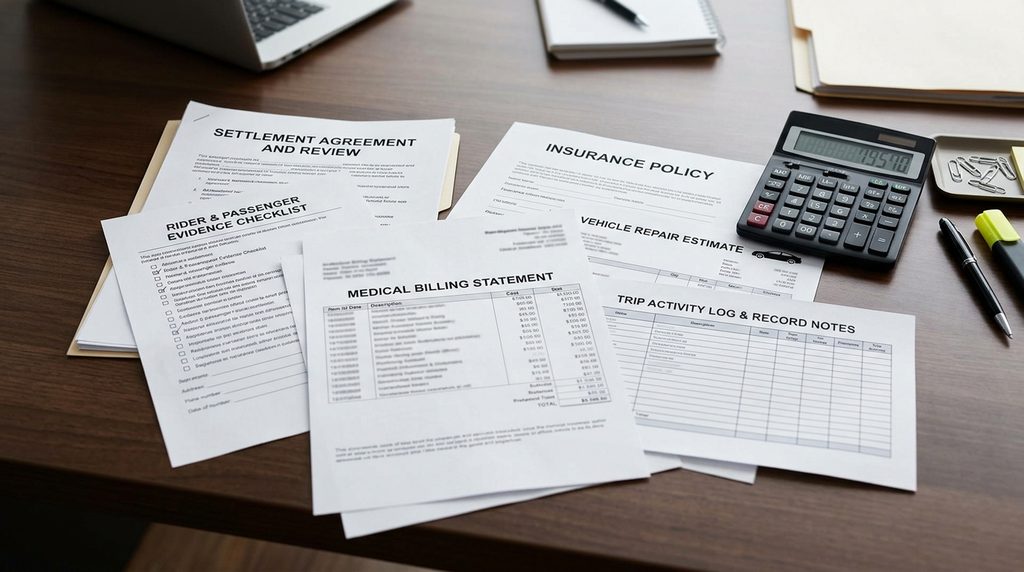
Practical Rideshare Passenger Claim Review Chart
| Claim Issue | Why It Matters | Useful Evidence |
| Active trip status | Helps identify coverage | App receipt, screenshots, TNC records |
| Pickup location | May affect which legal framework applies | Trip record, route map, app receipt |
| Driver fault | Shows whether the rideshare driver contributed | Police report, video, witness statements |
| Other driver fault | May create a claim against another policy | Insurance information, crash report, photos |
| No-fault benefits | Helps cover certain economic losses | No-fault forms, medical bills, wage records |
| Serious injury | May support pain and suffering recovery | Imaging, surgery notes, specialist reports |
| TNC insurance | May affect liability, UM, SUM, and no-fault review | Group policy information, claim letters |
| Policy limits | Affects practical recovery | Coverage disclosures, insurer letters |
Common Mistakes After a Rideshare Passenger Accident
Some mistakes can make a valid rideshare passenger claim harder to prove.
Common mistakes include:
- Not saving the app trip receipt
- Not taking screenshots of driver and trip details
- Not calling police
- Not getting the other driver’s information
- Not identifying witnesses
- Not photographing vehicle damage
- Not reporting the crash through the app
- Waiting too long to seek medical care
- Missing no-fault notice deadlines
- Not saving app messages or claim numbers
- Assuming the rideshare company handles every claim step
- Accepting an early settlement before treatment is clear
- Not checking UM or SUM coverage
- Not saving insurance letters
- Posting about the crash on social media
The strongest claims usually preserve app records, accident evidence, medical records, and insurance correspondence from the beginning.
How to Organize a Rideshare Passenger Claim File
A well-organized file can help explain the trip status, crash facts, medical treatment, and insurance coverage.
Useful folders may include:
- App trip receipt
- Driver and vehicle screenshots
- Pickup and drop-off details
- Police report
- DMV MV-104 report
- Scene photos
- Vehicle damage photos
- Witness information
- Dashcam footage
- Surveillance footage requests
- App support messages
- Rideshare claim number
- No-fault forms
- Insurance correspondence
- Medical records
- Medical bills
- Imaging reports
- Physical therapy records
- Work restriction notes
- Wage loss documents
- Policy documents
- Settlement offers
- Lien letters
Documents should be organized by date so the trip, crash, medical treatment, and insurance timeline are easy to follow.
Deadlines Still Matter
Rideshare passenger claims may involve several deadlines. These can include DMV crash reporting, no-fault notice, medical bill submissions, lost wage proof, insurance policy notice, UM or SUM notice, MVAIC deadlines, public entity notice, and lawsuit filing deadlines.
Important timing issues may include:
- MV-104 crash report timing
- No-fault written notice timing
- Medical bill submission timing
- Lost wage documentation
- TNC claim notice
- Insurance policy notice
- SUM notice
- MVAIC deadlines, if applicable
- Public entity notice, if a public vehicle or roadway issue is involved
- Lawsuit filing deadlines
- Discovery deadlines
- Settlement release timing
New York Courts lists three years for car accident claims and many negligence-based personal injury claims, but shorter insurance, no-fault, municipal, public authority, or policy notice deadlines may apply depending on the facts. New York Courts
When Legal Guidance May Be Useful
Legal guidance may be useful when a rideshare passenger is injured, the rideshare company or insurer disputes coverage, the app trip status is unclear, multiple vehicles were involved, the crash happened during a trip crossing New York City or Long Island boundaries, no-fault benefits are denied, the passenger has serious injuries, another driver was uninsured, or an early settlement offer arrives before medical treatment is complete.
A rideshare passenger claim review may require app receipts, trip screenshots, police reports, medical records, no-fault documents, TNC insurance information, driver insurance information, witness statements, video footage, wage records, policy disclosures, and settlement history.
People researching local support may review a Farmingdale legal office location when looking for Long Island rideshare accident claim information.
FAQs About Rideshare Passenger Injury Claims in New York
Can a rideshare passenger file an injury claim after an Uber or Lyft crash?
Yes. A rideshare passenger may have a claim for no-fault benefits and may also have a bodily injury claim against the rideshare driver, another driver, or another responsible party depending on who caused the crash and what insurance applies.
What evidence should a rideshare passenger save after a crash?
A passenger should save the app receipt, driver name, vehicle information, license plate, pickup and drop-off details, screenshots, police report, witness information, photos, medical records, no-fault documents, and insurance letters.
Does no-fault insurance apply to rideshare passengers?
No-fault benefits may apply after many New York motor vehicle accidents, including rideshare crashes. The correct insurer depends on the vehicle, trip status, policy language, and coverage facts. Written no-fault notice generally must be submitted within 30 days unless a clear and reasonable justification exists for late filing.
Why does rideshare app status matter?
App status can affect insurance coverage. A driver who is logged off, waiting for a ride, traveling to pick up a passenger, or actively transporting a passenger may trigger different coverage issues. Trip records and TNC data can help clarify coverage.
What if another driver caused the rideshare crash?
The passenger may have a claim against the other driver’s insurance while also reviewing no-fault benefits, TNC coverage, UM or SUM coverage, and other policies. Multiple insurance sources may need to be reviewed before settlement.
Final Thoughts
Rideshare passenger injury claims in New York require careful review because app status, pickup location, insurance coverage, no-fault benefits, driver fault, third-party fault, medical evidence, and deadlines may all affect the claim. A strong claim usually starts with preserving the app trip receipt, screenshots, police report, photos, witness information, medical records, insurance letters, and claim numbers. The key questions are whether the ride was active, who caused the crash, what coverage applies, and how the injuries affected the passenger’s health, work, and daily life.