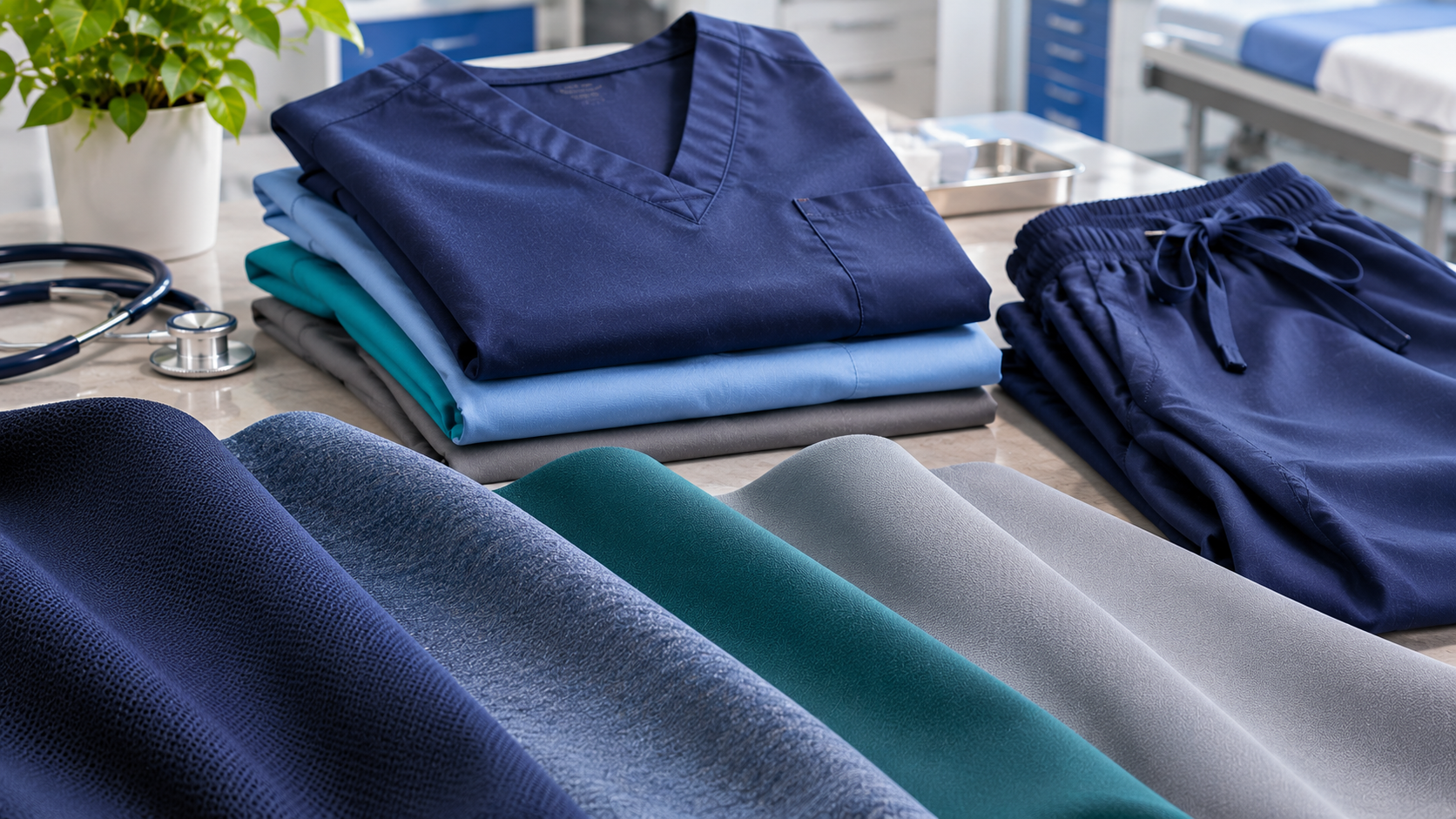
The fabric used in medical scrubs affects much more than how a uniform feels when it is first tried on. Fiber composition, fabric construction, stretch, weight, moisture behavior, durability, and wrinkle recovery can all influence how a garment performs during a healthcare workday.
For professionals who spend hours walking, standing, bending, reaching, and moving between different environments, understanding medical scrub fabrics can make it easier to choose uniforms that match their actual working conditions.
There is no single fabric that is best for every healthcare professional. A material that works well for an active hospital shift may feel different from one preferred in a quieter clinical environment. The better approach is to understand what different fibers contribute and then evaluate the complete fabric rather than judging a scrub only by its fiber label.
Quick Answer
The best scrub fabric balances comfort, mobility, durability, breathability, and easy care for the demands of the wearer’s workday. Fiber composition matters, but the percentage of each fiber and the way those fibers are knitted or woven can be just as important.
Key factors to consider include:
- Polyester: Often valued for durability, shape retention, and easy-care characteristics.
- Recycled polyester: Uses reclaimed polyester material as a feedstock and can provide textile properties comparable to conventional polyester, depending on the manufacturing process.
- Rayon: A regenerated cellulosic fiber associated with softness and drape.
- Spandex: Adds elasticity and stretch to a fabric blend.
- Fabric weight: Influences how substantial, warm, or lightweight a garment feels.
- Stretch: Can improve freedom of movement when properly balanced with structure.
- Breathability: Can affect comfort during activity and changing temperatures.
- Moisture behavior: Absorption, wicking, and drying are different properties and should not be treated as interchangeable.
- Care requirements: Frequent laundering makes maintenance an important part of fabric selection.
The most useful question is therefore not simply, “What fabric are these scrubs made from?” but “How does this particular fabric blend perform for the work I actually do?”
Why Does Scrub Fabric Matter?
Healthcare uniforms are worn in environments where clothing needs to accommodate repeated movement and frequent cleaning.
A healthcare professional may spend the same shift:
- Walking between patient rooms
- Standing for extended periods
- Sitting at a workstation
- Bending and reaching
- Assisting patients
- Moving equipment
- Working in warm or cool clinical areas
- Wearing additional layers
These activities place different demands on a garment.
A fabric with useful stretch may make repeated movement easier. A durable synthetic fiber may help a garment withstand frequent washing. A softer regenerated cellulosic fiber may change the feel and drape of a blend.
The fabric therefore contributes directly to how a scrub uniform feels and behaves over time.
What Are the Main Fibers Used in Medical Scrubs?
Many modern scrub fabrics use blends rather than a single fiber.
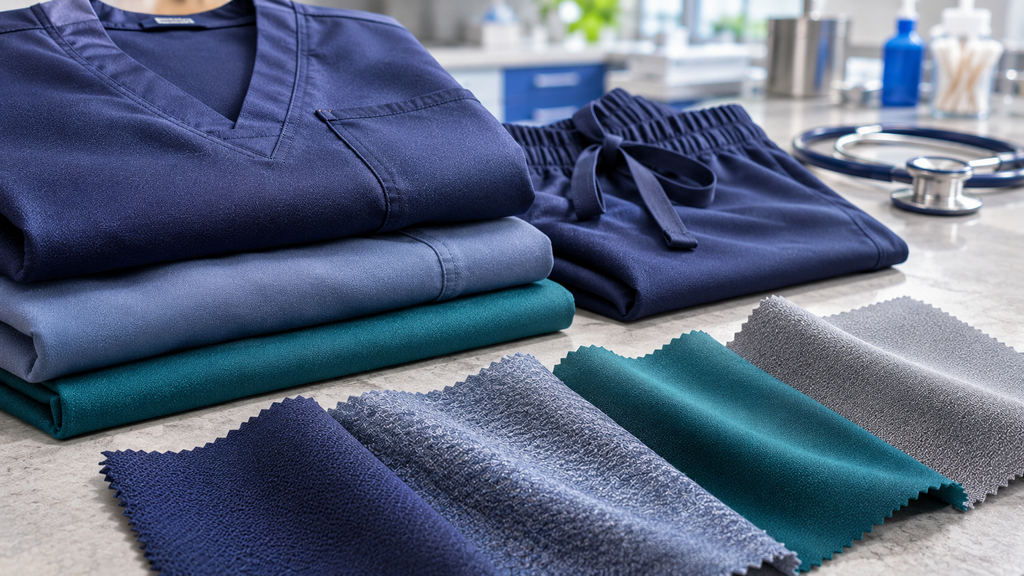
Common components include:
- Polyester
- Recycled polyester
- Rayon or viscose
- Spandex or elastane
- Cotton
- Other synthetic or regenerated fibers
Each material has different characteristics.
A blend is created to combine selected properties rather than relying entirely on one fiber.
For example, a polyester-rich fabric may emphasize durability and easy care, while a polyester-rayon-spandex blend may be designed to combine durability with softness, drape, and stretch.
What Does Polyester Add to Scrub Fabric?
Polyester is a manufactured synthetic fiber widely used in apparel.
It is commonly selected for workwear because it can provide useful durability and dimensional stability. Textile Exchange classifies polyester as a manmade synthetic fiber, while recycled polyester refers to polyester reprocessed from reclaimed pre- or post-consumer material. Textile Exchange material resources
In scrub fabrics, polyester can contribute to:
- Durability
- Shape retention
- Resistance to stretching
- Easy-care characteristics
- Quick-drying performance
- Abrasion resistance
This is one reason polyester is frequently used in healthcare apparel.
Is Polyester Good for Medical Scrubs?
It can be, particularly when durability and easy maintenance are important.
Healthcare uniforms can be washed repeatedly, so a fabric needs to tolerate regular care without quickly losing its intended shape or appearance.
Polyester can be useful for this purpose.
However, saying that polyester is “best” would be too broad. Comfort also depends on fabric construction, garment fit, weight, finishing, and the other fibers included in the blend.
A polyester-rich fabric designed for active work may feel very different from another polyester fabric with a different knit or finish.
What Is Recycled Polyester?
Recycled polyester, commonly abbreviated as rPET, is polyester made by reprocessing reclaimed material.
Textile Exchange identifies mechanical and chemical recycling approaches for polyester. Mechanical recycling processes the material and re-extrudes it, while chemical recycling breaks the polymer down and reforms it.
For apparel shoppers, the important distinction is that “recycled polyester” describes the source of the polyester rather than automatically describing the complete performance characteristics of the finished fabric.
The final garment still needs to be evaluated according to its actual construction and intended use.
What Does Rayon Add to Scrub Fabric?
Rayon is a regenerated cellulosic fiber made from cellulose.
It is associated with softness, drape, and a fluid appearance. The Council of Fashion Designers of America fiber guidedescribes rayon as a manufactured regenerated cellulosic fiber.
In scrub blends, rayon can contribute to:
- Soft hand feel
- Fluid drape
- A less rigid appearance
- Comfortable movement
- A softer feel against the skin
Rayon is therefore often used when a manufacturer wants to modify the feel of a primarily synthetic fabric.
However, rayon should not automatically be considered a superior or more sustainable choice. Its environmental characteristics depend heavily on how the fiber is produced and sourced.
What Does Spandex Do in Scrub Fabric?
Spandex, also known as elastane, is included primarily to provide elasticity.

Even a relatively small amount can change how a fabric behaves when stretched.
In medical scrubs, stretch can be useful when professionals:
- Bend
- Reach
- Squat
- Sit
- Stand
- Walk
- Lift
- Move patients or equipment
The important point is that stretch is not an independent measure of quality.
A garment needs enough structure to remain comfortable and maintain its intended fit while still allowing movement.
Is More Stretch Always Better?
No.
A fabric with more stretch is not automatically more comfortable or more durable.
Too much elasticity can change how a garment sits or recovers after repeated movement. A fabric with moderate stretch may provide a better balance between mobility and structure.
The appropriate amount depends on:
- Garment design
- Fiber blend
- Work activity
- Fit
- Personal preference
For healthcare work, the objective should be useful stretch, not simply maximum stretch.
What Is the Difference Between Stretch and Recovery?
Stretch describes how much a fabric can extend.
Recovery describes how well it returns toward its original shape after being stretched.
Both matter in workwear.
A scrub garment can feel flexible initially but still become less appealing if it does not recover well after repeated movement.
Good recovery can help a garment maintain a more consistent appearance during a long shift and after repeated wear.
Why Does Fabric Weight Matter?
Fabric weight affects the overall feel of a scrub uniform.

A lightweight fabric can feel:
- Less bulky
- Easier to layer
- More suitable for active work
- More comfortable in warmer conditions
A heavier fabric can feel:
- More substantial
- More structured
- Warmer
- More suitable for cooler environments
Neither is automatically better.
The ideal weight depends on the working environment and the amount of activity involved.
Are Lightweight Scrubs Better for Long Shifts?
They can be useful for professionals who spend much of the day moving.
A lightweight fabric can reduce the sensation of wearing a heavy layer for several hours.
However, lightweight does not automatically mean breathable, and breathable does not automatically mean moisture-wicking.
These characteristics need to be considered separately.
A well-designed lightweight fabric can be particularly useful when combined with appropriate stretch and a comfortable fit.
What Does Breathability Mean in Scrub Fabric?
Breathability generally refers to how readily air and moisture vapor can pass through a fabric.
It can affect comfort when a person becomes warm during activity.
However, breathability is influenced by more than fiber type.
Factors include:
- Fiber composition
- Yarn structure
- Knit or weave
- Fabric density
- Finishing
- Garment construction
- Fit
This means a fiber label alone cannot tell you exactly how breathable a finished scrub garment will feel.
Is Moisture-Wicking the Same as Moisture-Absorbing?
No.
These terms describe different behaviors.
Moisture absorption refers to a material taking up moisture.
Moisture wicking refers to the movement and spreading of moisture across a material, which can facilitate evaporation.
A fabric may exhibit one behavior, the other, or a combination of both.
This distinction is important when evaluating claims about performance fabrics. A fabric described as moisture-wicking should not automatically be assumed to absorb moisture in the same way as a highly absorbent fiber.
Why Does Quick-Dry Performance Matter?
Quick-dry performance can be useful for professionals who become warm or perspire during active work.
A fabric that dries relatively quickly can reduce the amount of time moisture remains in the garment.
However, drying speed depends on:
- Fiber composition
- Fabric thickness
- Construction
- Environmental conditions
- Amount of moisture
- Air movement
A quick-drying fabric is therefore one part of a broader comfort equation.
How Does Fabric Construction Affect Comfort?
Fiber composition tells only part of the story.
Two fabrics can contain similar fibers but feel completely different because they use different:
- Knitting techniques
- Weaving structures
- Yarn sizes
- Fabric densities
- Finishing processes
For example, a polyester-spandex knit designed for athletic movement may feel very different from a polyester woven fabric designed for a more structured appearance.
This is why fabric percentage alone should not be used to predict the entire wearing experience.
What Is a Fabric Blend?
A fabric blend combines two or more fiber types in a single textile.
The purpose is generally to combine useful characteristics.
Examples include:
Polyester + Spandex
Can combine durability and easy-care characteristics with stretch.
Polyester + Rayon + Spandex
Can combine synthetic durability with a softer, more fluid feel and elasticity.
Recycled Polyester + Spandex
Can combine polyester-based performance characteristics with stretch while using recycled polyester as a material input.
A blend should therefore be viewed as a design decision rather than simply a list of ingredients.
Why Are Polyester-Rayon-Spandex Blends Popular in Scrubs?
This type of blend can provide a balance between several desirable characteristics.
Rayon contributes softness and drape. Polyester contributes durability and structure. Spandex contributes elasticity.
The exact result depends on the percentages and fabric construction.
For example, one current scrub collection uses a 65% polyester, 32% rayon, and 3% spandex blend and describes the resulting fabric as lightweight, breathable, and flexible.
The specific blend demonstrates why the percentage matters: even a small amount of spandex can be intentionally incorporated alongside larger quantities of polyester and rayon to modify the fabric’s performance.
How Does Fabric Choice Affect Scrub Fit?
Fabric and fit work together.
A highly structured fabric can produce a more defined silhouette. A softer, more fluid fabric may drape closer to the body.
Stretch can also change how a garment accommodates movement.
This means the same nominal size can feel different depending on:
- Fiber blend
- Fabric construction
- Garment cut
- Stretch
- Rise
- Waistband
- Body proportions
A fabric should therefore be evaluated together with the garment’s design.
How Does Fabric Affect Scrub Durability?
Durability depends on the entire garment, not just the fiber.
Important factors include:
- Fiber strength
- Fabric construction
- Seam construction
- Finishing
- Laundering
- Frequency of wear
- Exposure to abrasion
Polyester can provide useful durability characteristics, but a durable fiber does not make every garment indestructible.
Proper care remains important.
How Does Fabric Affect Wrinkle Resistance?
Fiber characteristics and fabric construction influence how easily a garment wrinkles and how well it recovers afterward.
Polyester is commonly associated with wrinkle resistance and shape retention.
However, “wrinkle-resistant” should not be interpreted as “cannot wrinkle.”
Scrubs can still develop creases from:
- Sitting
- Folding
- Packing
- Compression
- Improper drying
- Storage while damp
Does Fabric Choice Affect Color Retention?
It can, but color retention depends on more than the fiber itself.
Dye chemistry, fabric preparation, finishing, washing conditions, detergent, water temperature, and drying can all affect the appearance of dyed textiles over time.
This is particularly relevant for healthcare uniforms because they may be washed frequently.
The safest approach is to follow the garment’s care instructions rather than assuming that a particular fiber guarantees permanent color.
How Often Should Medical Scrubs Be Washed?
The appropriate laundering frequency depends on workplace requirements, the nature of the work, and whether the garment has become contaminated.
Healthcare organizations may have their own policies.
The CDC infection-control guidance addresses safe handling and processing of healthcare textiles and contaminated garments.
Always follow workplace policy and the garment manufacturer’s care instructions.
How Does Laundering Affect Scrub Fabric?
Repeated laundering can affect:
- Color
- Elasticity
- Shape
- Surface texture
- Seams
- Finishes
The impact depends on the fabric and the washing process.
This is another reason easy-care characteristics can matter when choosing workwear.
Healthcare professionals who wear scrubs frequently should consider not only how a fabric feels on day one but how it is expected to perform after repeated cleaning.
Does the CDC Recommend a Specific Scrub Fabric?
The CDC does not establish a universal “best scrub fabric” for ordinary healthcare uniforms.
Its guidance focuses on safe handling and laundering of healthcare textiles and contaminated garments rather than prescribing one universal fiber blend.
This distinction matters because fabric selection is influenced by the work environment, garment function, facility requirements, and manufacturer specifications.
Are Scrubs Sterile?
Ordinary scrub apparel should not automatically be considered sterile.
The CDC distinguishes hygienically clean textiles from sterile textiles. Textiles used in healthcare settings are generally processed to achieve hygienic cleanliness rather than sterility.
Specific procedures that require sterile textiles or surgical garments have separate requirements.
Does Fabric Matter in the Operating Room?
Yes, but fabric selection in perioperative environments should be considered within the facility’s surgical-attire policies.
The AORN surgical attire resources address surgical attire and perioperative clothing considerations. Healthcare organizations can establish policies appropriate to their environments.
This means a scrub fabric that is comfortable for general clinical work may not automatically meet every operating-room requirement.
What Should Healthcare Professionals Look for in Scrub Fabric?
A practical evaluation should include several characteristics.
For Active Jobs
Prioritize:
- Stretch
- Mobility
- Lightweight construction
- Breathability
- Quick-dry performance
- Durable construction
For Cooler Environments
Consider:
- Moderate fabric weight
- Layering compatibility
- Comfortable structure
- Appropriate coverage
For Long Shifts
Consider:
- Comfort
- Stretch
- Breathability
- Shape retention
- Moisture behavior
- Easy care
For Frequent Washing
Look for:
- Durable construction
- Reliable color retention
- Shape recovery
- Clear care instructions
- Easy-care characteristics
Which Scrub Fabric Is Best for Nurses?
There is no universal answer.
Nurses often spend substantial time walking, standing, bending, reaching, and assisting patients, so mobility and comfort may be especially important.
A useful starting point is a fabric that combines:
- Comfortable stretch
- Appropriate weight
- Breathability
- Durable construction
- Practical care requirements
The exact blend should then be selected according to the individual’s preferences and work environment.
Which Scrub Fabric Is Best for Physicians?
Physicians may have different requirements depending on their clinical setting.
Someone working primarily in an office-based environment may prioritize appearance and structure, while a physician working in a high-movement clinical environment may place greater emphasis on stretch and breathability.
A fabric that maintains a polished appearance while allowing movement can be useful across many settings.
Which Scrub Fabric Is Best for Medical Students?
Medical students often move between different environments during training.
A versatile fabric can therefore be useful.
Consider:
- Moderate weight
- Comfortable stretch
- Easy care
- Breathability
- Professional appearance
A versatile fabric may be more practical than selecting a garment optimized for only one type of clinical environment.
Which Scrub Fabric Is Best for High-Movement Jobs?
For high-movement work, prioritize flexibility without sacrificing garment stability.
A fabric containing an appropriate amount of stretch can make bending and reaching easier.
However, the garment’s cut matters just as much as the fabric.
Even a highly elastic fabric can feel restrictive if the shoulders, thighs, rise, or other areas are poorly proportioned.
How Do You Compare Two Scrub Fabrics?
Instead of asking which fabric is universally better, compare them across the characteristics that matter to your work.
| Factor | What to Consider |
| Fiber composition | What materials make up the blend? |
| Stretch | How much flexibility does the fabric provide? |
| Recovery | Does it return toward its original shape? |
| Weight | Does it feel lightweight or substantial? |
| Breathability | Does it allow comfortable heat and moisture movement? |
| Moisture behavior | Does it absorb, spread, or dry moisture effectively? |
| Durability | Can it withstand frequent use and care? |
| Wrinkle behavior | How easily does it crease and recover? |
| Care | What laundering does the manufacturer specify? |
| Drape | Does it hang softly or maintain more structure? |
This approach gives a more realistic assessment than relying on fiber names alone.
Does a More Expensive Fabric Mean Better Scrubs?
Not necessarily.
Price can reflect many factors, including:
- Fiber quality
- Fabric construction
- Garment design
- Manufacturing
- Finishing
- Brand positioning
- Distribution
- Additional features
A more expensive scrub may not be more comfortable for a particular wearer.
The better approach is to identify the properties that matter most for the workday and evaluate whether the garment provides them.
How Do You Choose Between Cotton and Synthetic Blends?
Cotton and synthetic blends can provide different wearing experiences.
Cotton is a natural fiber valued for its familiar feel, while synthetic blends can be engineered around properties such as durability, stretch, shape retention, and quick drying.
The choice depends on priorities.
Someone who strongly prefers a natural-feeling fabric may favor a cotton-rich garment, while someone prioritizing easy care, stretch, and quick drying may prefer a synthetic blend.
There is no single correct answer.
Is Rayon More Comfortable Than Polyester?
That depends on the fabric construction and the wearer’s preferences.
Rayon is associated with softness and drape, while polyester can contribute durability and easy-care characteristics.
A blend can combine characteristics from both.
Rather than choosing based on the name of one fiber, consider how the complete fabric feels and performs.
What Does “Performance Fabric” Mean in Scrubs?
“Performance fabric” is a broad term rather than a single standardized fiber category.
It can refer to fabrics designed around characteristics such as:
- Stretch
- Quick drying
- Wrinkle resistance
- Breathability
- Moisture management
- Durability
- Easy care
Because the term is broad, shoppers should look for the specific performance characteristics being claimed rather than assuming that “performance” means the same thing across every garment.
What Does “Soft Scrub Fabric” Mean?
Softness generally describes the hand feel of the textile.
It can be influenced by:
- Fiber type
- Yarn structure
- Fabric construction
- Finishing
- Surface treatment
A soft fabric is not automatically more durable, breathable, or suitable for high-movement work.
Softness should therefore be treated as one factor in the overall evaluation.
How Important Is Fabric Drape?
Drape describes how a fabric hangs and conforms to gravity.
A fluid drape can create a softer, less rigid appearance. A structured fabric can maintain a more defined silhouette.
Rayon is often associated with fluid drape, which is one reason it is used in blends intended to provide a softer appearance and feel.
Drape can be especially noticeable in women’s scrub tops and pants, where garment silhouette is an important part of the overall fit.
How Does Fabric Affect Professional Appearance?
Fabric influences appearance through:
- Drape
- Wrinkle recovery
- Surface texture
- Color
- Shape retention
- Fit
A fabric that maintains its shape and resists excessive creasing can help a uniform remain polished throughout the workday.
However, garment fit remains equally important.
A high-quality fabric cannot compensate for an incorrect size or poorly matched silhouette.
Should Scrub Fabric Be Chosen Before Scrub Style?
Not always.
The best approach is to consider both simultaneously.
For example:
- A jogger may benefit from stretch and recovery.
- A tailored top may benefit from a fabric with good drape and shape retention.
- A jacket may need enough structure for layering.
- A wide-leg pant may feel different depending on fabric weight.
Fabric and garment design are interconnected.
How Should You Match Fabric to Your Workday?
Start by identifying the demands of the job.
If You Walk Constantly
Look for:
- Lightweight construction
- Stretch
- Breathability
- Quick-dry characteristics
If You Work in a Cool Facility
Consider:
- Moderate weight
- Layering compatibility
- Comfortable coverage
If You Sit and Stand Frequently
Prioritize:
- Stretch
- Recovery
- Comfortable waistband
- Appropriate rise
If You Wash Uniforms Frequently
Consider:
- Durable fibers
- Shape retention
- Color care
- Easy-care characteristics
If Appearance Matters Throughout the Shift
Look for:
- Wrinkle resistance
- Shape recovery
- Appropriate drape
- Stable color
What Should You Check on a Scrub Product Label?
Before purchasing, look for:
- Fiber percentages
- Care instructions
- Available sizes
- Available lengths
- Stretch claims
- Performance claims
- Manufacturer-specific fabric information
Fiber percentages are particularly useful because “polyester blend” or “stretch fabric” alone does not explain the actual composition.
Why Should Fiber Percentages Matter?
The percentage of each fiber can substantially change the feel and performance of a blend.
For example, a fabric containing a small amount of spandex may behave differently from one containing a much higher percentage.
Likewise, a polyester-heavy rayon blend may feel different from a rayon-heavy blend.
The percentages therefore provide useful context when comparing garments.
What Are the Biggest Scrub Fabric Selection Mistakes?
Choosing Based Only on Softness
Softness is valuable, but it does not tell you how the garment will perform during an entire shift.
Assuming More Stretch Is Better
Stretch must be balanced with recovery and structure.
Ignoring Fabric Weight
The wrong weight can make a uniform uncomfortable in a particular environment.
Confusing Wicking With Absorption
These describe different moisture behaviors.
Ignoring Care Requirements
A fabric that requires more maintenance may not be practical for someone who wears scrubs every day.
Choosing by Fiber Name Alone
The same fiber can perform differently depending on construction and finishing.
Ignoring Workplace Requirements
Perioperative and other specialized environments can have specific attire policies.
Key Takeaways
Choosing the right scrub fabric requires looking beyond the name printed on the fiber label.
The most important points are:
- Polyester can contribute durability and easy-care properties.
- Recycled polyester uses reclaimed polyester material as a feedstock.
- Rayon can contribute softness and fluid drape.
- Spandex provides elasticity and can improve freedom of movement.
- Fabric weight influences how substantial or lightweight a uniform feels.
- Stretch should be balanced with recovery and structure.
- Breathability, absorption, wicking, and quick drying are different characteristics.
- Fabric construction can be just as important as fiber composition.
- Frequent laundering makes durability and care requirements especially relevant.
- Workplace policies should always be considered for specialized clinical environments.
The best stretch medical scrubs are not necessarily the ones with the greatest amount of elasticity. The better choice is a fabric that provides the right combination of flexibility, recovery, comfort, durability, and fit for the work being performed.
Frequently Asked Questions
What is the best fabric for medical scrubs?
There is no universally best fabric for every healthcare professional. Polyester blends can offer durability and easy-care characteristics, while rayon blends can provide softness and drape. Spandex can add stretch. The best choice depends on work activity, climate, fit, laundering requirements, and personal preference.
Is polyester good for medical scrubs?
Yes, polyester can be well suited to healthcare workwear because it can provide durability, shape retention, quick-drying behavior, and easy-care characteristics. The overall performance still depends on the specific fabric construction and the other fibers in the blend.
What does spandex do in scrub fabric?
Spandex, also called elastane, provides elasticity. It allows the fabric to stretch and can make garments more comfortable during bending, reaching, sitting, walking, and other repeated movements.
Is rayon good for scrubs?
Rayon can be useful in scrub blends because it is associated with softness and fluid drape. However, rayon has different production and care considerations, so the complete fabric and manufacturer’s instructions should be evaluated rather than judging the garment by rayon content alone.
Are lightweight scrubs better for long shifts?
Lightweight scrubs can be useful during long shifts, particularly for active professionals who prefer less bulk. However, lightweight construction does not automatically guarantee breathability or comfort. Fit, fabric construction, stretch, moisture behavior, and the work environment all matter.
Are recycled polyester scrubs durable?
Recycled polyester can have mechanical properties comparable to virgin polyester, although actual performance depends on the material and manufacturing process. Individual end uses should still be evaluated according to their requirements.
How often should healthcare scrubs be washed?
Laundering frequency depends on the workplace, the nature of the work, contamination, and facility policy. Healthcare organizations may establish specific requirements. Follow workplace procedures and the garment manufacturer’s care instructions.
Does fabric determine how comfortable scrubs are?
Fabric is an important factor, but it is not the only one. Garment cut, size, waistband, seam placement, fabric weight, stretch, and construction can all affect comfort. A high-quality fabric can still feel uncomfortable if the garment is poorly fitted.
Conclusion
Scrub fabric plays a major role in how a healthcare uniform feels and performs, but there is no single material that works best for every professional or every clinical environment.
Polyester can contribute durability and easy-care properties. Recycled polyester provides an alternative material input while retaining polyester-based textile characteristics. Rayon can contribute softness and drape, while spandex introduces elasticity and flexibility. The final performance depends on how these fibers are combined, the percentages used, the fabric construction, and the garment’s design.
For professionals looking for medical scrub fabrics, the most useful approach is to evaluate the complete material rather than relying on a single label such as “stretch,” “breathable,” or “performance.” Fabric weight, recovery, moisture behavior, durability, care requirements, and fit should all be considered together.
Work environment matters just as much. A professional who spends a long shift walking and assisting patients may prioritize lightweight stretch and breathability, while someone working in a cooler or more stationary environment may prefer more structure or weight.
Finally, healthcare uniforms need to be maintained according to manufacturer instructions and workplace policies. The CDC emphasizes appropriate handling and laundering of healthcare textiles, while perioperative organizations may establish additional requirements for surgical attire.
The best scrub fabric is ultimately the one whose fiber composition, construction, weight, stretch, and care requirements match the demands of the person wearing it.